


Page 158 - Inventions - A Visual Encyclopedia (DK - Smithsonian)
P. 158
The camera


          Pinhole cameras were used in ancient times

          to project images, but they couldn’t take a
          picture—that had to wait until the 1820s.

          The first photographs took several hours
          of exposure in the camera. Now, with
      COMMUNICATION  and view them instantly.
          digital technology, we can take pictures


                                                          An aperture allows light
                    WOW!                                       into the camera.

                The earliest known
                                                                   THE FIRST SNAPS
             photograph was taken by                         The first photographs, taken by
           Joseph Nicéphore Niépce in                 Joseph Nicéphore Niépce in the 1820s,
              1826. It shows the view                  were very crude. It was his colleague,
             from an upstairs window                     Louis Daguerre, who developed the
                at his country estate                  first viable photographic process. The
                     in France.                             1839 Giroux Daguerreotype was

                                                               the world’s first commercially
                                                                        produced camera.
          SILVER SHOTS
          Daguerreotype images, like this
          one (right) from 1843, were
          made by exposing a silver-
          coated copper plate for a few                                                  A tripod holds
          minutes. The faint image was                                                     the camera
                                                                                          steady during
          developed to full visibility using                                              the exposure.
          mercury fumes. William Fox Talbot
          created the “calotype,” another early                                   Giroux
          photographic process, in 1841. Unlike the daguerreotype, an             Daguerreotype, 1839
          unlimited number of prints could be made from one calotype.


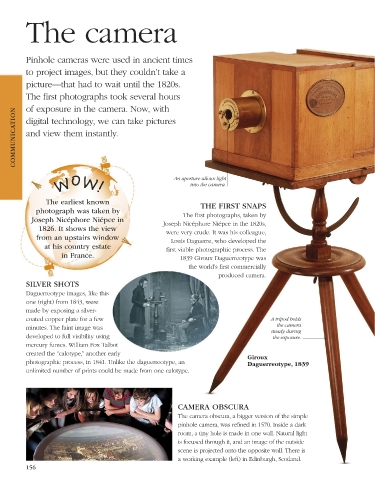
                                                           CAMERA OBSCURA
                                                           The camera obscura, a bigger version of the simple
                                                           pinhole camera, was refined in 1570. Inside a dark
                                                           room, a tiny hole is made in one wall. Natural light
                                                           is focused through it, and an image of the outside
                                                           scene is projected onto the opposite wall. There is
                                                           a working example (left) in Edinburgh, Scotland.
          156


   US_156-157_308121_Camera.indd   156                                                                           08/03/2018   17:17

