


Page 254 - Inventions - A Visual Encyclopedia (DK - Smithsonian)
P. 254
Studying the stars


          People have been fascinated by stars and planets since prehistoric times, but
          for thousands of years they could only study them with their unaided eyes.

          In the 17th century, telescopes opened up new ways of seeing the universe,
          and astronomers have been building bigger and better instruments ever since.


      SPACE  Reflector                                 Photo of Orion nebula, 1883      Infrared camera view, 2010
          telescope, 1724


          WHAT IS A TELESCOPE?
          Telescopes use a large lens or mirror to
          collect light, and a smaller lens called the
          eyepiece to create images of distant objects   ASTROPHOTOGRAPHY
          that are brighter and larger than those    After the invention of photography in the 19th century,
          formed by our normal eyesight. The         astronomers soon attached cameras to telescopes. Cameras
          principle was discovered by the Dutch      can collect light over long periods, creating bright images
          lensmaker Hans Lippershey around 1608.     that reveal much more detail than human eyesight can
                                                     detect. Modern electronic cameras can detect types of
                                                     light, such as infrared, that are invisible to human eyes.


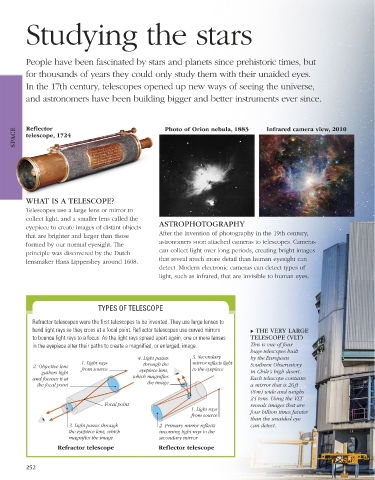
                                 TYPES OF TELESCOPE

            Refractor telescopes were the first telescopes to be invented. They use large lenses to
            bend light rays so they cross at a focal point. Reflector telescopes use curved mirrors    ▶ THE VERY LARGE
            to bounce light rays to a focus. As the light rays spread apart again, one or more lenses   TELESCOPE (VLT)
            in the eyepiece alter their paths to create a magnified, or enlarged, image.  This is one of four
                                                                                   huge telescopes built
                                              4. Light passes   3. Secondary       by the European
                           1. Light rays        through the     mirror reflects light   Southern Observatory
            2. Objective lens   from source                     to the eyepiece
               gathers light                   eyepiece lens,                      in Chile’s high desert.
            and focuses it at               which magnifies                        Each telescope contains
             the focal point                     the image                         a mirror that is 26 ft
                                                                                   (8 m) wide and weighs
                                                                                   24 tons. Using the VLT
                                   Focal point                                     reveals images that are
                                                               1. Light rays       four billion times fainter
                                                               from source
                                                                                   than the unaided eye
                        3. Light passes through      2. Primary mirror reflects    can detect.
                        the eyepiece lens, which     incoming light rays to the
                        magnifies the image          secondary mirror
                    Refractor telescope              Reflector telescope


          252


   US_252-253_Studying_the_stars_Main.indd   252                                                                 09/03/18   4:06 PM

