


Page 256 - Inventions - A Visual Encyclopedia (DK - Smithsonian)
P. 256
Telescopes

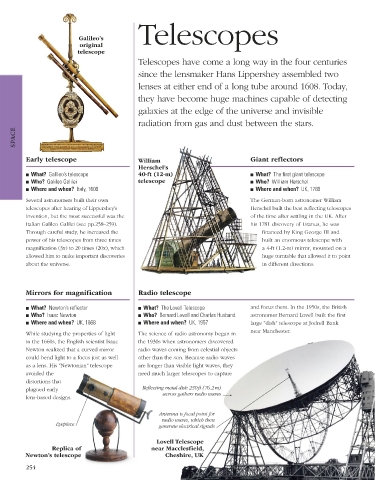
                           Galileo’s
                           original
                          telescope
                                              Telescopes have come a long way in the four centuries
                                              since the lensmaker Hans Lippershey assembled two

                                              lenses at either end of a long tube around 1608. Today,
                                              they have become huge machines capable of detecting

                                              galaxies at the edge of the universe and invisible
                                              radiation from gas and dust between the stars.
      SPACE


         Early telescope                      William                              Giant reflectors
                                              Herschel’s
         ■ ■ What?  Galileo’s telescope       40-ft (12-m)                         ■ ■ What?  The first giant telescope
         ■ ■ Who?  Galileo Galilei            telescope                            ■ ■ Who?  William Herschel
         ■ ■ Where and when?  Italy, 1609                                          ■ ■ Where and when?  UK, 1789
         Several astronomers built their own                                       The German-born astronomer William
         telescopes after hearing of Lippershey’s                                  Herschel built the best reflecting telescopes
         invention, but the most successful was the                                of the time after settling in the UK. After
         Italian Galileo Galilei (see pp.258–259).                                 his 1781 discovery of Uranus, he was
         Through careful study, he increased the                                       financed by King George III and
         power of his telescopes from three times                                      built an enormous telescope with
         magnification (3x) to 20 times (20x), which                                   a 4-ft (1.2-m) mirror, mounted on a
         allowed him to make important discoveries                                     huge turntable that allowed it to point
         about the universe.                                                           in different directions.


         Mirrors for magnification            Radio telescope

         ■ ■ What?  Newton’s reflector        ■ ■ What?  The Lovell Telescope      and focus them. In the 1950s, the British
         ■ ■ Who?  Isaac Newton               ■ ■ Who?  Bernard Lovell and Charles Husband  astronomer Bernard Lovell built the first
         ■ ■ Where and when?  UK, 1668        ■ ■ Where and when?  UK, 1957        large “dish” telescope at Jodrell Bank
                                                                                   near Manchester.
         While studying the properties of light    The science of radio astronomy began in
         in the 1660s, the English scientist Isaac   the 1930s when astronomers discovered
         Newton realized that a curved mirror    radio waves coming from celestial objects
         could bend light to a focus just as well    other than the sun. Because radio waves
         as a lens. His “Newtonian” telescope   are longer than visible light waves, they
         avoided the                          need much larger telescopes to capture
         distortions that
         plagued early                          Reflecting metal dish 250 ft (76.2 m)
                                                      across gathers radio waves
         lens-based designs.

                                                     Antenna is focal point for
                                                      radio waves, which then
                   Eyepiece                          generate electrical signals

                                                    Lovell Telescope
                  Replica of                      near Macclesfield,
         Newton’s telescope                            Cheshire, UK
          254


   US_254-255_Telescopes_Gallery.indd   254                                                                      08/03/18   3:10 PM

