


Page 257 - Inventions - A Visual Encyclopedia (DK - Smithsonian)
P. 257
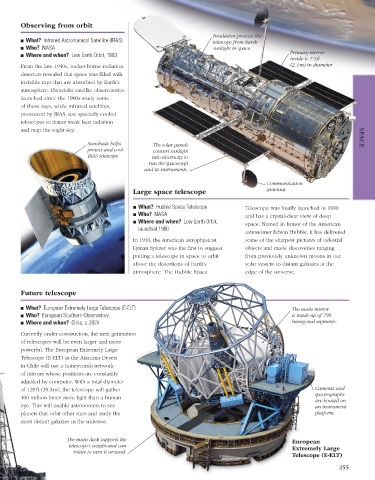
Observing from orbit

                                                                       Insulation protects the
        ■ ■ What?  Infrared Astronomical Satellite (IRAS)              telescope from harsh
        ■ ■ Who?  NASA                                                 sunlight in space.
        ■ ■ Where and when?  Low Earth Orbit, 1983                                              Primary mirror
                                                                                                inside is 7.9 ft
        From the late 1940s, rocket-borne radiation                                             (2.4 m) in diameter
        detectors revealed that space was filled with
        invisible rays that are absorbed by Earth’s
        atmosphere. Ultraviolet satellite observatories
        launched since the 1960s study some
        of these rays, while infrared satellites,
        pioneered by IRAS, use specially cooled
        telescopes to detect weak heat radiation
        and map the night sky.

                              Sunshade helps       The solar panels                                                    SPACE
                              protect and cool     convert sunlight
                              IRAS telescope       into electricity to
                                                  run the spacecraft
                                                and its instruments.

                                                                                        Communication
                                            Large space telescope                       antenna


                                            ■ ■ What?  Hubble Space Telescope    Telescope was finally launched in 1990
                                            ■ ■ Who?  NASA                       and has a crystal-clear view of deep
                                            ■ ■ Where and when?  Low Earth Orbit,     space. Named in honor of the American
                                              launched 1990
                                                                                 astronomer Edwin Hubble, it has delivered
                                            In 1946, the American astrophysicist    some of the sharpest pictures of celestial
                                            Lyman Spitzer was the first to suggest   objects and made discoveries ranging
                                            putting a telescope in space to orbit    from previously unknown moons in our
                                            above the distortions of Earth’s     solar system to distant galaxies at the
                                            atmosphere. The Hubble Space         edge of the universe.


        Future telescope

        ■ ■ What?  European Extremely Large Telescope (E-ELT)                                   The main mirror
        ■ ■ Who?  European Southern Observatory                                                 is made up of 798
        ■ ■ Where and when?  Chile, c. 2024                                                     hexagonal segments.
        Currently under construction, the next generation
        of telescopes will be even larger and more
        powerful. The European Extremely Large
        Telescope (E-ELT) in the Atacama Desert
        in Chile will use a honeycomb network
        of mirrors whose positions are constantly
        adjusted by computer. With a total diameter
        of 129 ft (39.3 m), the telescope will gather                                                   Cameras and
                                                                                                        spectrographs
        100 million times more light than a human
                                                                                                        are housed on
        eye. This will enable astronomers to see                                                        an instrument
        planets that orbit other stars and study the                                                    platform.
        most distant galaxies in the universe.


                       The main deck supports the                                               European
                        telescope’s weight and can                                              Extremely Large
                         rotate to turn it around.
                                                                                                Telescope (E-ELT)
                                                                                                                255


   US_254-255_Telescopes_Gallery.indd   255                                                                      08/03/18   6:37 PM

