


Page 281 - Inventions - A Visual Encyclopedia (DK - Smithsonian)
P. 281
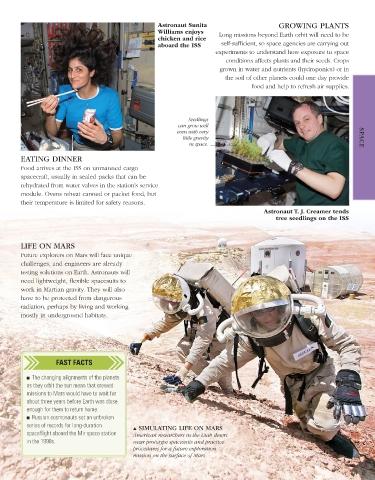
Astronaut Sunita                       GROWING PLANTS
                                                     Williams enjoys     Long missions beyond Earth orbit will need to be
                                                     chicken and rice
                                                     aboard the ISS      self-sufficient, so space agencies are carrying out
                                                                       experiments to understand how exposure to space
                                                                           conditions affects plants and their seeds. Crops
                                                                         grown in water and nutrients (hydroponics) or in
                                                                           the soil of other planets could one day provide
                                                                                   food and help to refresh air supplies.


                                                               Seedlings
                                                           can grow well
                                                           even with very
                                                             little gravity                                            SPACE
                                                               in space.

        EATING DINNER
        Food arrives at the ISS on unmanned cargo
        spacecraft, usually in sealed packs that can be
        rehydrated from water valves in the station’s service
        module. Ovens reheat canned or packet food, but
        their temperature is limited for safety reasons.
                                                                                       Astronaut T. J. Creamer tends
                                                                                           tree seedlings on the ISS


        LIFE ON MARS
        Future explorers on Mars will face unique
        challenges, and engineers are already
        testing solutions on Earth. Astronauts will
        need lightweight, flexible spacesuits to
        work in Martian gravity. They will also
        have to be protected from dangerous
        radiation, perhaps by living and working
        mostly in underground habitats.


                   FAST FACTS


          ■ ■ The changing alignments of the planets
          as they orbit the sun mean that crewed
          missions to Mars would have to wait for
          about three years before Earth was close
          enough for them to return home.
          ■ ■ Russian cosmonauts set an unbroken
          series of records for long-duration   ▲ SIMULATING LIFE ON MARS
          spaceflight aboard the Mir space station   American researchers in the Utah desert
          in the 1990s.                     wear prototype spacesuits and practice
                                            procedures for a future exploration
                                            mission on the surface of Mars.


   US_278-279_Living_in_space_Gallery.indd   279                                                                 08/03/18   3:10 PM

