


Page 39 - (DK Eyewitness) Travel Guide - Sweden
P. 39
INTRODUCING SWEDEN 37
THE HISTORY
OF SWEDEN
Described in the 4th century BC as a land of frozen seas and midnight sun, this
northerly nation of reindeer herders also produced the fearsome Viking traders
of the 9th century. By the 17th century, Sweden, in its Age of Greatness, ruled
supreme over the Baltic region. Vanquished by Russia in 1809, the country
adopted a more peaceful role and today is heavily engaged in world affairs.
In the last 100,000 years, Sweden has been with its frozen seas and midnight sun. In his
covered by thick inland ice on at least three Germania (AD 98), the Roman Tacitus refers
occasions. As the ice retreated northwards to the “sviones” as a powerful people with
for the last time in approximately 12,000 BC, strong men, weapons and fleets.
nomadic reindeer hunters moved in to use With the growth of the Roman Empire,
the newly revealed land, but it was not until links with the Continent increased and
6500 BC that Sweden was entirely free of ice. numerous finds show evidence of trade
Farming was gradually adopted in with Rome via the many German tribes in
southern Sweden from 4000 BC, while the area north of the Rhine. The fall of
hunting continued to remain prevalent in Rome and the subsequent period of
the inland areas of Norrland for a long population migrations saw the rise of small
time to come. The first examples of kingdoms across Europe. In Sweden there
domestic pottery date from this period was a kingdom centred on Uppsala where
and burial mounds appeared in the large kungshögar (King’s Mounds) can still
southern provinces. be seen today (see p135).
Finds from the Bronze Age (1800–500 BC) From 800 until Christianity reached
bear witness to increased contact with the Sweden in the mid-11th century, the
outside world. A chieftain society based Vikings took the world by storm. As traders,
on power and social alliances began to settlers and plunderers, they set sail in
develop. Magnificent bronze objects, search of land, slaves and treasure. They
huge burial mounds and cairns with grave carried out raids throughout Europe, sailed
goods as well as rock carvings date from as far as Baghdad and even reached
this period (see p216). America. Christian monks wrote of attacks
The transition to the Iron Age in 500 BC on rich monasteries and towns. But the
saw the first written accounts about Vikings were more than wild barbarians.
Scandinavia. In the 4th century BC the They were also hard-working farmers,
Greek explorer and trader, Phytheas of traders, experienced sailors, craftsmen
Massilia, described the journey to “Thule”, and shipbuilders.
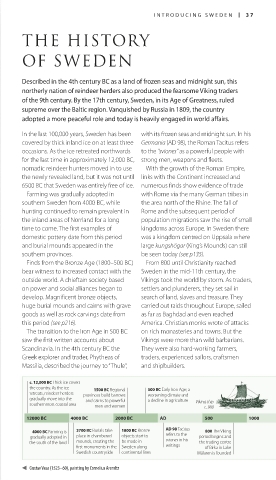
c. 12,000 BC Thick ice covers
the country. As the ice 1500 BC Regional 500 BC Early Iron Age; a
retreats, reindeer herders provinces build barrows worsening climate and
gradually move into the and cairns to powerful a decline in agriculture
southernmost coastal area men and women Viking ship
c. 980
12000 BC 4000 BC 2000 BC AD 500 1000
4000 BC Farming is 3700 BC Burials take 1800 BC Bronze AD 98 Tacitus 800 The Viking
gradually adopted in place in chambered objects start to refers to the period begins and
the south of the land mounds, creating the be made in sviones in his the trading centre
first monuments in the Sweden along writings of Birka in Lake
Swedish countryside continental lines Mälaren is founded
Gustav Vasa (1523–60), painting by Cornelius Arendtz
036-037_EW_Sweden.indd 37 11/07/16 11:47 am

