


Page 40 - (DK Eyewitness) Travel Guide - Sweden
P. 40
38 INTRODUCING SWEDEN
Christianity and the Birth of Once the Stenkil dynasty came to an end
a Kingdom around 1120, the royal houses of
During the 11th and 12th centuries several Västergötland (Erik) and Östergötland
families from different provinces battled for (Sverker) battled for supremacy. Both
power over the central part of what is families died out in the first half of the 13th
known today as Sweden. The country was century at the time when the power of the
more like a federation of self-governing riksjarl (earl) was at its height. The riksjarl
provinces, a number of which, for a limited was the king’s most important statesman
time, had influence over those around them. and the position gained greater influence
Little is known of the kings and chieftains in through Birger Magnusson, known as Birger
the early Middle Ages other than brief Jarl, who became riksjarl in 1248 under King
mentions in sagas. In the 11th century, King Erik Eriksson. Until his death in 1266, Birger
Olof Skötkonung (d. 1020) was converted to Jarl was the de facto wielder of power in
Christianity and was baptized in 1008, along Sweden, which by then had developed into
with his sons Anund Jakob (d. 1050) and a medieval kingdom similar to those
Edmund the Old (d. 1060). Thereafter power elsewhere in Europe.
passed to the Stenkil family, which had strong
links with Västergötland where the Christian The Hanseatic League and the Bjälbo
church had gained the most influence. Dynasty’s Power Struggle
The church and the gradual transition to The 13th century saw the founding of
Christianity underway in the 12th century many of the medieval towns still standing
were vital to the growing power of the today. Documents show that Stockholm
king. The priests brought with them an existed as a town in 1252, four years after
administrative tradition, a civil service and a Birger Jarl became riksjarl. In 1289 it was
rational system for regulating property. The described as the largest town in Sweden,
church also reinforced the strength of the but it was not yet a capital city. Its
king ideologically through the idea that his importance lay in its role as a trading
power was derived from God. centre, particularly for the German
Hanseatic League, during the 14th century.
The Hanseatic League had previously
established a base in Visby on Gotland,
which was one of its most important centres.
In some places, the Hansa influence was so
great that the king had to prevent Germans
from holding more than half of the leading
positions in the town.
Through Birger Jarl’s son, Valdemar,
elected king in 1250, power passed to the
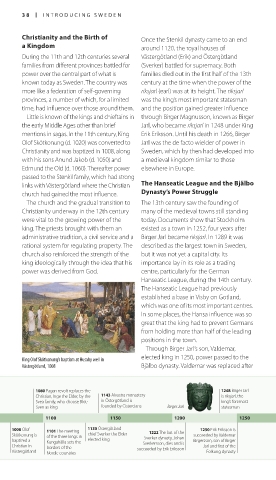
King Olof Skötkonung’s baptism at Husaby well in
Västergötland, 1008 Bjälbo dynasty. Valdemar was replaced after
1080 Pagan revolt replaces the 1248 Birger Jarl
Christian, Inge the Elder, by the 1143 Alvastra monastery is riksjarl, the
Svea family, who choose Blot- in Östergötland is king’s foremost
Sven as king founded by Cistercians Birger Jarl statesman
1100 1150 1200 1250
1008 Olof 1101 The meeting 1130 Östergötland 1250 Erik Eriksson is
Skötkonung is of the three kings in chief Sverker the Elder 1222 The last of the succeeded by Valdemar
baptized a Kungahälla sets the elected king Sverker dynasty, Johan Birgersson, son of Birger
Christian in borders of the Sverkersson, dies and is Jarl and first of the
Västergötland Nordic countries succeeded by Erik Eriksson Folkung dynasty
038-039_EW_Sweden.indd 38 11/07/16 11:47 am
Eyewitness Travel LAYERS PRINTED:
History Portrait template “UK” LAYER
(Source v1.2)
Date 20th August 2012
Size 125mm x 217mm

