


Page 41 - (DK Eyewitness) Travel Guide - Sweden
P. 41
THE HIST OR Y OF SWEDEN 39
a revolt by his brother Magnus Ladulås who
was elected king in 1275. During Magnus’s
reign, Swedish legislation was reformed and
the Ordinance of Alsnö of 1280 granted the
nobility and church far-reaching privileges
and freedom from taxation.
The king’s nickname, Ladulås (literally “lock
barn”), is said to derive from his ban on nobles
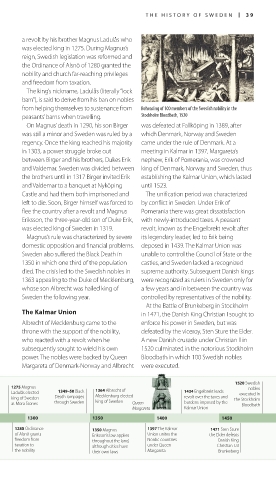
from helping themselves to sustenance from Beheading of 100 members of the Swedish nobility in the
peasants’ barns when travelling. Stockholm Bloodbath, 1520
On Magnus’ death in 1290, his son Birger was defeated at Fallköping in 1389, after
was still a minor and Sweden was ruled by a which Denmark, Norway and Sweden
regency. Once the king reached his majority came under the rule of Denmark. At a
in 1303, a power struggle broke out meeting in Kalmar in 1397, Margareta’s
between Birger and his brothers, Dukes Erik nephew, Erik of Pomerania, was crowned
and Valdemar. Sweden was divided between king of Denmark, Norway and Sweden, thus
the brothers until in 1317 Birger invited Erik establishing the Kalmar Union, which lasted
and Valdemar to a banquet at Nyköping until 1523.
Castle and had them both imprisoned and The unification period was characterized
left to die. Soon, Birger himself was forced to by conflict in Sweden. Under Erik of
flee the country after a revolt and Magnus Pomerania there was great dissatisfaction
Eriksson, the three-year-old son of Duke Erik, with newly-introduced taxes. A peasant
was elected king of Sweden in 1319. revolt, known as the Engelbrekt revolt after
Magnus’s rule was characterized by severe its legendary leader, led to Erik being
domestic opposition and financial problems. deposed in 1439. The Kalmar Union was
Sweden also suffered the Black Death in unable to control the Council of State or the
1350 in which one third of the population castles, and Sweden lacked a recognized
died. The crisis led to the Swedish nobles in supreme authority. Subsequent Danish kings
1363 appealing to the Duke of Mecklenburg, were recognized as rulers in Sweden only for
whose son Albrecht was hailed king of a few years and in between the country was
Sweden the following year. controlled by representatives of the nobility.
At the Battle of Brunkeberg in Stockholm
The Kalmar Union in 1471, the Danish King Christian I sought to
Albrecht of Mecklenburg came to the enforce his power in Sweden, but was
throne with the support of the nobility, defeated by the viceroy, Sten Sture the Elder.
who reacted with a revolt when he A new Danish crusade under Christian II in
subsequently sought to wield his own 1520 culminated in the notorious Stockholm
power. The nobles were backed by Queen Bloodbath in which 100 Swedish nobles
Margareta of Denmark-Norway and Albrecht were executed.
1520 Swedish
1275 Magnus nobles
Ladulås elected 1349–50 Black 1364 Albrecht of 1434 Engelbrekt leads executed in
king of Sweden Death rampages Mecklenburg elected revolt over the taxes and the Stockholm
at Mora Stones through Sweden king of Sweden Queen burdens imposed by the Bloodbath
Margareta Kalmar Union
1250 1300 1350 1400 1450
1280 Ordinance 1350 Magnus 1397 The Kalmar 1471 Sten Sture
of Alsnö grants Eriksson’s law applies Union unites the the Elder defeats
freedom from throughout the land, Nordic countries Danish King
taxation to although cities have under Queen Christian I at
the nobility their own laws Margareta Brunkeberg
038-039_EW_Sweden.indd 39 11/07/16 11:48 am

