


Page 22 - World of Animals - Issue #33
P. 22
Otters of the world

            Giant otters battle with


            jaguars for prey


            The giants of the otter world go head to head with
            big cats in a never-ending competition for food

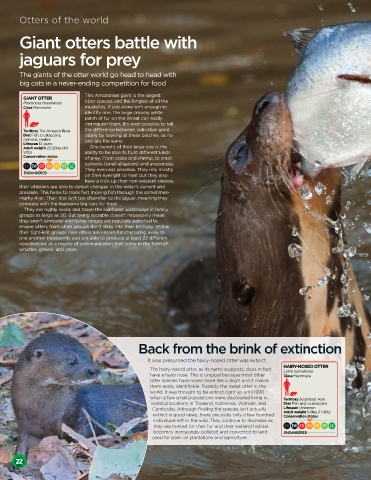
                                   This Amazonian giant is the largest
             GIANT OTTER
             Pteronura brasiliensis  otter species and the longest of all the
             Class Mammalia        mustelids. If size alone isn’t enough to
                                   identify one, the large creamy white
                                   patch of fur on the throat can easily
                                   distinguish them. It’s even possible to tell
             Territory The Amazon River  the difference between individual giant
             Diet Fish, crustaceans,   otters by looking at these patches, as no
             caimans, snakes       two are the same.
             Lifespan 12 years

             Adult weight 22-26kg (49-  One benefit of their large size is the
             57lb)                 ability to be able to hunt different kinds
             Conservation status   of prey. From crabs and shrimp, to small
                                   caimans (small alligators) and anacondas.
                                   They even eat piranhas. They rely mostly
              ENDANGERED
                                   on their eyesight to hunt but they also
                                   have a trick up their non-existent sleeves;
            their whiskers are able to detect changes in the water’s current and
            pressure. This helps to track fast moving fish through the sometimes-

            murky river. Their diet isn’t too dissimilar to the jaguar, meaning they
            compete with the fearsome big cats for food.
              They are highly social and travel the rainforest waterways in family
            groups as large as 20. But being sociable doesn’t necessarily mean
            they aren’t territorial and home ranges are regularly patrolled to
            ensure otters from other groups don’t stray into their territory. Within
            their tight-knit groups river otters are known for chattering away to
            one another incessantly and are able to produce at least 22 different
            vocalisations as a means of communication that come in the form of
            whistles, growls, and yelps.


                                                      Back from the brink of extinction


                                                         It was presumed the hairy-nosed otter was extinct
                                                                                                         HAIRY-NOSED OTTER
                                                          The hairy-nosed otter, as its name suggests, does in fact   Lutra sumatrana
                                                          have a hairy nose. This is unusual because most other   Class Mammalia
                                                          otter species have noses more like a dog’s and it makes

                                                          them easily identifiable. Possibly the rarest otter in the
                                                          world, it was thought to be extinct right up until 1998
                                                          when a few small populations were discovered living in   Territory Southeast Asia
                                                          isolated locations in Thailand, Indonesia, Vietnam, and   Diet Fish and crustaceans

                                                           Cambodia. Although finding the species isn’t actually   Lifespan Unknown
                                                           extinct is good news, there are sadly only a few hundred   Adult weight 5-8kg (11-18lb)
                                                                                                         Conservation status
                                                           individuals left in the wild. They continue to decrease as
                                                           they are hunted for their fur and their wetland habitat
                                                           becomes increasingly polluted and converted to land   ENDANGERED
                                                           used for palm oil plantations and agriculture.


           22

