


Page 56 - World of Animals - Issue #33
P. 56
Alien invasion


            Eating fish out of their homes


            These predatory lionfish might look fancy, but they’re not fussy
            eaters – much to the chagrin of the Caribbean’s native habitants
            Genetic research suggests the majority of the Atlantic’s   population is expanding at an unsustainable rate. As


            lionfish population originate from just a handful of   many as 1,000 fish have been recorded in a single
            specimens – purportedly six fish that escaped from a   acre in some areas.


            Miami aquarium amidst the chaos of Hurricane Andrew   This gluttonous fish will feast on practically anything
            in 1992. That was all that was needed for this prolific   that will fit in its mouth – it’s been recorded making


            and aggressive breeder to take a stranglehold on the   a dinner out of over 50 different species. Capable of


            region’s already frail coral reef ecosystems.   munching 20 small fish in just half an hour, the lionfish
              A single female can lay as many as 2 million eggs in   outcompetes the waters’ native predators and deprives
            a single year and with no natural predators, the lionfish   the reef of species that keep algae levels in check.

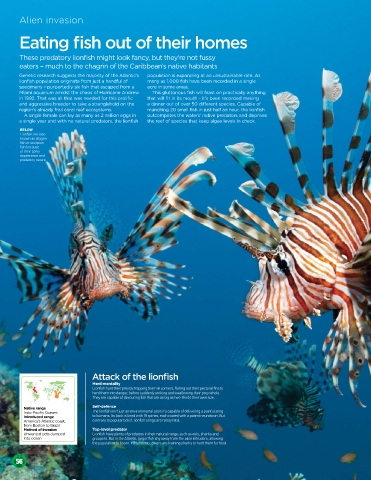
            BELOW
            Lionfi sh are also
            known as dragon
            fi sh or scorpion
            fi  sh  because
            of their spiky
            appearance and
            predatory nature


                                      Attack of the lionfish

                                      Herd mentality
                                      Lionfish hunt their prey by trapping them in corners, flaring out their pectoral fins to


                                      herd them into danger, before suddenly striking and swallowing their prey whole.

                                      They are capable of devouring fish that are as big as two-thirds their own size.
                                      Self-defence
              Native range

              Indo-Pacific Oceans      The lionfish isn't just an environmental pest; it's capable of delivering a painful sting

              Introduced range        to humans. Its back is lined with 18 spines, each coated with a potent neurotoxin. But

              America’s Atlantic coast,   contrary to popular belief, lionfish stings are rarely fatal.
              from Boston to Brazil
              Method of invasion      Top-level predator
              Unwanted pets dumped    Lionfish have plenty of predators in their natural range, such as eels, sharks and

              into ocean              groupers. But in the Atlantic, larger fish shy away from the alien intruders, allowing

                                      the population to boom. In Honduras, divers are training sharks to hunt them for food.
           56

