


Page 59 - World of Animals - Issue #33
P. 59
Alien invasion


              Tiny invaders,               The imported menace
               huge impacts                The Caribbean native is a cantankerous insect that’s blazing a trail of
               These tiny terrors have taken   destruction through the southern United States
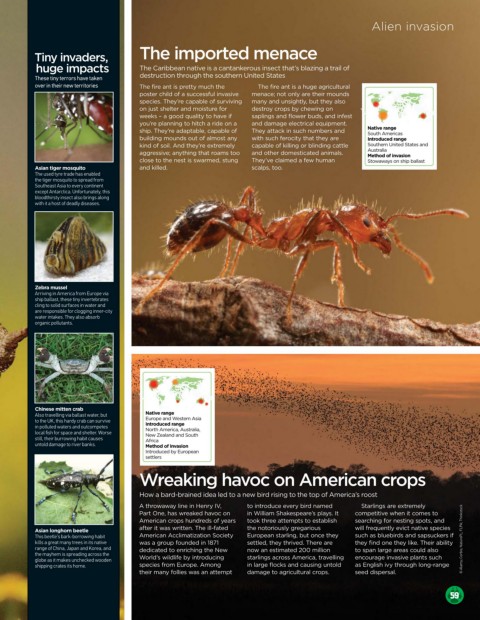
               over in their new territories  The fire ant is pretty much the   The fire ant is a huge agricultural


                                           poster child of a successful invasive   menace; not only are their mounds
                                           species. They’re capable of surviving   many and unsightly, but they also
                                           on just shelter and moisture for   destroy crops by chewing on

                                           weeks – a good quality to have if   saplings and flower buds, and infest
                                           you’re planning to hitch a ride on a   and damage electrical equipment.
                                           ship. They’re adaptable, capable of   They attack in such numbers and   Native range
                                                                                                         South Americas
                                           building mounds out of almost any   with such ferocity that they are   Introduced range
                                           kind of soil. And they’re extremely   capable of killing or blinding cattle   Southern United States and
                                           aggressive; anything that roams too   and other domesticated animals.   Australia
                                                                                                         Method of invasion
                                           close to the nest is swarmed, stung   They’ve claimed a few human   Stowaways on ship ballast
               Asian tiger mosquito        and killed.                    scalps, too.
               The used tyre trade has enabled
               the tiger mosquito to spread from
               Southeast Asia to every continent
               except Antarctica. Unfortunately, this
               bloodthirsty insect also brings along
               with it a host of deadly diseases.


               Zebra mussel
               Arriving in America from Europe via
               ship ballast, these tiny invertebrates
               cling to solid surfaces in water and
               are responsible for clogging inner-city
               water intakes. They also absorb
               organic pollutants.


               Chinese mitten crab
               Also travelling via ballast water, but   Native range
               to the UK, this hardy crab can survive   Europe and Western Asia
                                             Introduced range
               in polluted waters and outcompetes   North America, Australia,
               local fish for space and shelter. Worse   New Zealand and South

               still, their burrowing habit causes   Africa
               untold damage to river banks.  Method of invasion
                                             Introduced by European
                                             settlers
                                           Wreaking havoc on American crops


                                           How a bard-brained idea led to a new bird rising to the top of America’s roost
                                           A throwaway line in Henry IV,   to introduce every bird named   Starlings are extremely
                                           Part One, has wreaked havoc on   in William Shakespeare’s plays. It   competitive when it comes to
                                           American crops hundreds of years   took three attempts to establish   searching for nesting spots, and
               Asian longhorn beetle       after it was written. The ill-fated   the notoriously gregarious   will frequently evict native species
               This beetle’s bark-borrowing habit   American Acclimatization Society   European starling, but once they   such as bluebirds and sapsuckers if  © Alamy; Corbis; NaturePL; FLPA; Thinkstock

               kills a great many trees in its native   was a group founded in 1871   settled, they thrived. There are   they find one they like. Their ability
               range of China, Japan and Korea, and   dedicated to enriching the New   now an estimated 200 million   to span large areas could also
               the mayhem is spreading across the   World’s wildlife by introducing   starlings across America, travelling   encourage invasive plants such
               globe as it makes unchecked wooden

               shipping crates its home.   species from Europe. Among   in large flocks and causing untold   as English ivy through long-range
                                           their many follies was an attempt   damage to agricultural crops.   seed dispersal.
                                                                                                                               59

