


Page 58 - World of Animals - Issue #33
P. 58
Alien invasion

            The out-of-control pest


            Toxic to animals and humans, the cane toad is more than just a pest
            In an attempt to curb fire ant numbers, American   the roots of sugar cane crops. In the process, Australia

            researchers are pondering whether to introduce its   ended up with an even bigger pest on their hands.
            natural enemies from South America. Before they do   Like most invasive species, cane toads multiply   Native range
                                                                                                       Central and South America
            that, they would do well to consider the precautionary   rapidly and there are no predators to keep their   Introduced range
            tale of the cane toad. This highly toxic toad was   population in check. Their numbers are now so high   Australia
            introduced to Australia in the 1930s to control the   that for some commuters, running over dozens of cane   Method of invasion
                                                                                                       Introduced for pest control
            numbers of local grub beetles, whose larvae destroy   toads is just part of the daily grind.
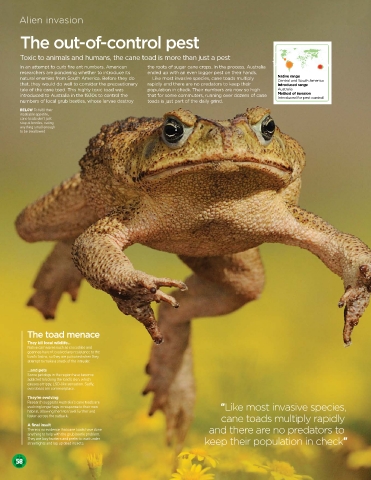
            BELOW To fulfi l their
            insatiable appetite,
            cane toads don’t just
            stop at beetles, eating
            anything small enough
            to be swallowed


               The toad menace
               They kill local wildlife...
               Native carnivores such as crocodiles and
               goannas haven’t evolved any resistance to the
               toad’s toxins, so they are poisoned when they
               attempt to make a snack of the intruder.
               ...and pets
               Some pet dogs in the region have become
               addicted to licking the toad’s skin, which
               causes a trippy, LSD-like sensation. Sadly,
               overdoses are commonplace.
               They’re evolving
               Research suggests Australia’s cane toads are
               evolving longer legs in response to their new                       “Like most invasive species,
               habitat, allowing them to travel further and
               faster across the outback.                                          cane toads multiply rapidly

               A final insult
               There is no evidence that cane toads have done                  and there are no predators to
               anything to help with the grub beetle problem.
               They are lazy hunters and prefer to wait under                keep their population in check”
               streetlights and lap up dead insects.
           58

