


Page 64 - World of Animals - Issue #33
P. 64
Giant African land snail


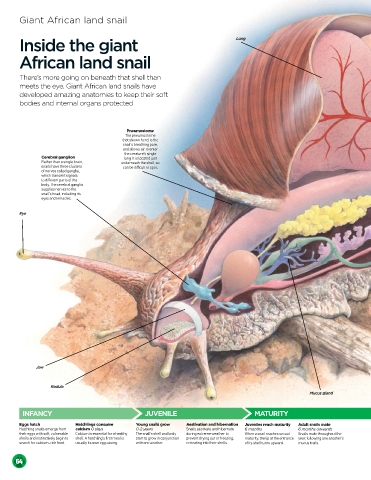
            Inside the giant                                                            Lung


            African land snail


            There’s more going on beneath that shell than
            meets the eye. Giant African land snails have
            developed amazing anatomies to keep their soft
            bodies and internal organs protected


                                                  Pneumostome
                                                 The pneumostome
                                                (not shown here) is the
                                                snail’s breathing pore,
                                                and allows air to enter
                                                 the creature’s single
                    Cerebral ganglion            lung. It is located just
                    Rather than a single brain,   underneath the shell, so
                    snails have three clusters   can be diffi cult to spot.

                    of nerves called ganglia,
                    which transmit signals
                    to different parts of the

                    body. The cerebral ganglia
                    supplies nerves to the
                    snail’s head, including its
                    eyes and tentacles.
            Eye


                  Jaw


                       Radula
                                                                                                                  Mucus gland


             INFANCY                                    JUVENILE                               MATURITY

            Eggs hatch          Hatchlings consume   Young snails grow   Aestivation and hibernation  Juveniles reach maturity  Adult snails mate
            Hatchling snails emerge from   calcium 0 days  0-2 years   Snails aestivate and hibernate   6 months  6 months onwards

            their eggs with so , vulnerable   Calcium is essential for a healthy   The snail’s shell and body   during extreme weather to   When a snail reaches sexual   Snails mate throughout the

            shells and instinctively begin to   shell. A hatchling’s first meal is   start to grow in conjunction   prevent drying out or freezing,   maturity, the lip at the entrance  year, following one another’s
            search for calcium-rich food.  usually its own egg casing.  with one another.  retreating into their shells.  of its shell turns upward.  mucus trails.
           64

