


Page 62 - World of Animals - Issue #33
P. 62
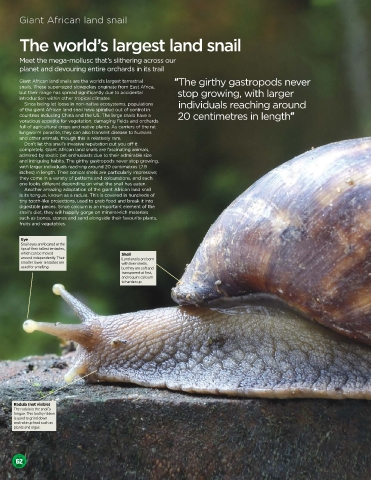
Giant African land snail


            The world’s largest land snail


            Meet the mega-mollusc that’s slithering across our
            planet and devouring entire orchards in its trail
            Giant African land snails are the world’s largest terrestrial   “The girthy gastropods never
            snails. These super-sized slowpokes originate from East Africa,
            but their range has spread significantly due to accidental   stop growing, with larger
            introduction within other tropical climates.
              Since being let loose in non-native ecosystems, populations   individuals reaching around
            of the giant African land snail have spiralled out of control in
            countries including China and the US. The large snails have a   20 centimetres in length”
            voracious appetite for vegetation, damaging fields and orchards
            full of agricultural crops and native plants. As carriers of the rat
            lungworm parasite, they can also transmit disease to humans
            and other animals, though this is relatively rare.
              Don’t let this snail’s invasive reputation put you off it
            completely. Giant African land snails are fascinating animals,
            admired by exotic pet enthusiasts due to their admirable size
            and intriguing habits. The girthy gastropods never stop growing,
            with larger individuals reaching around 20 centimetres (7.9
            inches) in length. Their conical shells are particularly impressive;
            they come in a variety of patterns and colourations, and each
            one looks different depending on what the snail has eaten.
              Another amazing adaptation of the giant African land snail
            is its tongue, known as a radula. This is covered in hundreds of
            tiny tooth-like projections, used to grab food and break it into
            digestible pieces. Since calcium is an important element of the
            snail’s diet, they will happily gorge on mineral-rich materials
            such as bones, stones and sand alongside their favourite plants,
            fruits and vegetables.

             Eye
             Snail eyes are located at the
             tips of their tallest tentacles,
             which can be moved                 Shell
             around independently. Their        Land snails are born
             smaller lower tentacles are        with their shells,
             used for smelling.                 but they are so
 and
                                                transparent at first,
                                                and require calcium
                                                to harden up.


          Radula (not visible)
          The radula is the snail’s
          tongue. This toothy ribbon
          is used to grind down
          and rake up food such as
          plants and algae.


           62

