


Page 63 - World of Animals - Issue #33
P. 63
Brilliant breeders

              They might be viewed as pests, but the giant African land   It is usually the larger snail that acts
              snail’s worldwide invasion is testament to its amazing   as the female during the mating process,
              reproductive capabilities. A single snail has the potential to   and goes on to lay eggs. However, if the
              lay around 200 eggs at a time, with a hatchling survival rate   snails are a similar size, it is possible
              of around 90 per cent. Newborn snails only take around six   for them to simultaneously exchange
              months to reach sexual maturity, so a once snail-free area   eggs and sperm, resulting in them both

              can soon become infested with plant-chomping molluscs.  producing offspring.
                Giant African land snails are hermaphrodites, meaning   Each snail holds on to sperm from
              they have both male and female reproductive organs.   multiple partners. They then fertilise and
              Although they don’t technically need a partner to reproduce,   lay their eggs in fi ve or six clutches over the
              they will always mate with another snail if one can be found.   course of a year. Once the eggs have been
              Young snails will usually look out for an older partner, as this   deposited in a nest, the young are on their own
              is more likely to result in successful breeding.  – the parents will have no role in raising them.


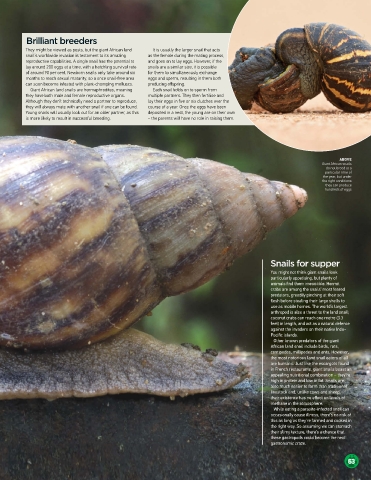
                                                                                                                             ABOVE
                                                                                                                      Giant African snails
                                                                                                                        do not breed at a
                                                                                                                        particular time of
                                                                                                                       the year, but under
                                                                                                                      the right conditions
                                                                                                                        they can produce
                                                                                                                       hundreds of eggs


                                                                                                    Snails for supper
                                                                                                    You might not think giant snails look
                                                                                                    particularly appetising, but plenty of
                                                                                                    animals find them irresistible. Hermit

                                                                                                    crabs are among the snails’ most feared
                                                                                                    predators, greedily pinching at their so
                                                                                                    flesh before stealing their large shells to

                                                                                                    use as mobile homes. The world’s largest
                                                                                                    arthropod is also a threat to the land snail;
                                                                                                    coconut crabs can reach one metre (3.3
                                                                                                    feet) in length, and act as a natural defence
                                                                                                    against the invaders on their native Indo-
                                                                                                    Pacifi  c  islands.
                                                                                                     Other known predators of the giant
                                                                                                    African land snail include birds, rats,
                                                                                                    centipedes, millipedes and ants. However,
                                                                                                    the most notorious land snail eaters of all
                                                                                                    are humans. Just like the escargots found
                                                                                                    in French restaurants, giant snails boast an
                                                                                                    appealing nutritional combination – they’re
                                                                                                    high in protein and low in fat. Snails are
                                                                                                    also much easier to farm than traditional
                                                                                                    livestock and, unlike cows and sheep,

                                                                                                    their existence has no effect on levels of
                                                                                                    methane in the atmosphere.
                                                                                                     While eating a parasite-infected snail can
                                                                                                    occasionally cause illness, there’s no risk of
                                                                                                    this as long as they’re farmed and cooked in
                                                                                                    the right way. So assuming we can stomach
                                                                                                    their slimy texture, there’s a chance that
                                                                                                    these gastropods could become the next
                                                                                                    gastronomic craze.

                                                                                                                               63

