


Page 80 - World of Animals - Issue #33
P. 80
Wildlife of the African savannah
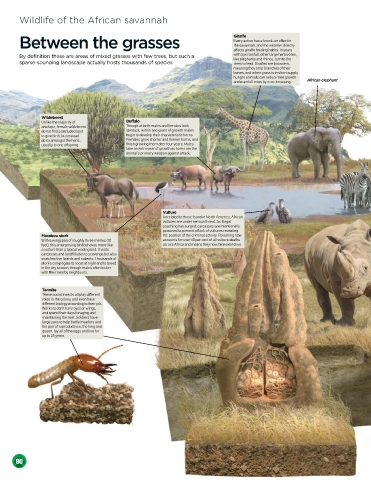
Between the grasses Giraffe
Every action has a knock-on effect in
the savannah, and the weather directly
affects giraffe feeding habits. In years
By definition these are areas of mixed grasses with few trees, but such a with low rainfall, other large herbivores,
sparse-sounding landscape actually hosts thousands of species like elephants and rhinos, turn to the
trees to feed. Giraffes are browsers,
meaning they strip branches of their
leaves, and when grass is in short supply
hungry animals can reduce tree growth
and even kill trees by over-browsing. African elephant
Wildebeest
Unlike the majority of Buffalo
antelope, female wildebeest Though at birth males and females look
do not find a secluded spot identical, within two years of growth males
to give birth, but instead begin to develop their characteristic horns.
do so amongst the herd , Females grow shorter and thinner horns, and
usually to one offspring. finish growing them aer four years. Males
take an extra year of growth as horns are the
animal’s primary weapon against attack.
Vulture
Unrelated to those found in North America, African
vultures are under serious threat. As illegal
poaching has surged, carcasses are intentionally
poisoned to prevent a flock of vultures revealing
Marabou stork the position of the criminal activity. Poisoning now
With a wingspan of roughly three metres (10 accounts for over 60 per cent of all vulture deaths
feet), this enterprising bird behaves more like across Africa and means they now face extinction.
a vulture than a typical wading bird. It visits
carcasses and landfill sites to scavenge but also
snatches live lizards and rodents. Thousands of
storks congregate to roost at night and to breed
in the dry season, though males oen bicker
with their nearby neighbours.
Termite
These social insects all play different
roles in the colony, and even have
different biology according to their job.
Workers don’t have eyes or wings,
and spend their days foraging and
maintaining the nest. Soldiers have
large jaws to help battle invaders and
the pair of reproductives, the king and
queen, lay all of the eggs and live for
up to 25 years.
80

