


Page 82 - World of Animals - Issue #33
P. 82
Wildlife of the African savannah


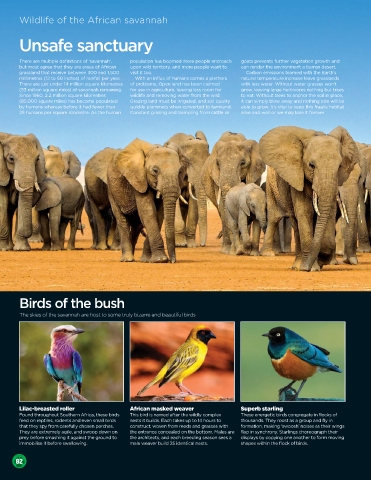
            Unsafe sanctuary


            There are multiple definitions of ‘savannah’,   population has boomed more people encroach   goats prevents further vegetation growth and

            but most agree that they are areas of African   upon wild territory, and more people want to   can render the environment a barren desert.
            grassland that receive between 300 and 1,500   visit it too.                    Carbon emissions teamed with the Earth’s
            millimetres (12 to 60 inches) of rainfall per year.   With an influx of humans comes a plethora   natural temperature increase leave grasslands

            There are just under 14 million square kilometres   of problems. Open land has been claimed   with less water. Without water grasses won’t
            (53 million square miles) of savannah remaining.   for use in agriculture, leaving less room for   grow, leaving large herbivores nothing but trees
            Since 1960, 2.2 million square kilometres   wildlife and removing water from the wild.   to eat. Without trees to anchor the soil in place,
            (85,000 square miles) has become populated   Grazing land must be irrigated, and soil quality   it can simply blow away and nothing else will be
            by humans whereas before it had fewer than   quickly plummets when converted to farmland.   able to grow. It’s vital to keep this fragile habitat
            25 humans per square kilometre. As the human   Constant grazing and trampling from cattle or   alive and well or we may lose it forever.


            Birds of the bush


            The skies of the savannah are host to some truly bizarre and beautiful birds


            Lilac-breasted roller                  African masked weaver                  Superb starling

            Found throughout Southern Africa, these birds   This bird is named after the wildly complex   These energetic birds congregate in flocks of

            feed on reptiles, rodents and even small birds   nests it builds. Each takes up to 14 hours to   thousands. They roost as a group and fly in
            that they spy from carefully chosen perches.   construct, woven from reeds and grasses with   formation, making ‘swoosh’ noises as their wings

            They are extremely agile, and swoop down on   the entrance concealed on the bottom. Males are   flap in synchrony. Starlings choreograph their
            prey before smashing it against the ground to   the architects, and each breeding season sees a   displays by copying one another to form moving
            immobilise it before swallowing.       male weaver build 25 identical nests.  shapes within the flock of birds.

           82

