


Page 84 - World of Animals - Issue #33
P. 84
L
L
L OST FOREVER
L
OST FOREVER
OST FOREVER
Yunnan lake newt
A deadly combination of catastrophic events lead to
the rapid decline and ultimate extinction of what was
the rapid decline and ultimate extinction of what was
one of the world’s most colourful newts
one of the world’s most colourful newts
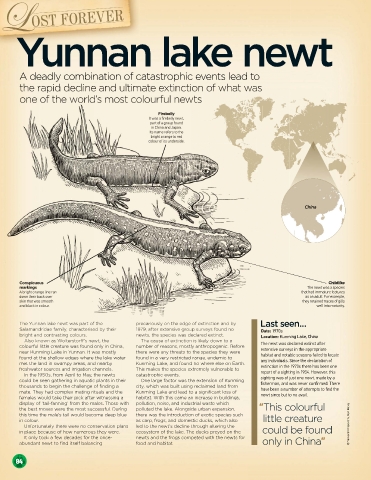
Firebelly
Firebelly
It was a fi
It was a firebelly newt,
rebelly newt,
part of a group found
part of a group found
in China and Japan.
in China and Japan.
Its name refers to the
Its name refers to the
bright orange to red
bright orange to red
colour of its underside.
colour of its underside.
China
Conspicuous
Conspicuous Childlike
markings The newt was a species
markings
A bright orange line ran
A bright orange line ran that had immature features
down their back over
down their back over as an adult. For example,
skin that was smooth they retained traces of gills
skin that was smooth
and black in colour.
and black in colour. well into maturity.
een
s
L
…
as
t
The Yunnan lake newt was part of the
T h e Y u n n a n l a k e n e w t w a s p a r t o f t h e p r e c a r i o u s l y o n t h e e d g e o f e x t i n c t i o n a n d b y Last seen…
precariously on the edge of extinction and by
7
9
e
v
e g
i
n
s
t
r e
f
S a l am an d r i d a e f am i l y , c h ar ac t e r i s e d b y t h e i r 1 1979, after extensive group surveys found no Date: 1970s
Salamandridae family, characterised by their
t
, a
9
e
x
u
s f
y
p s
u
r
v
o
o
r
o
d n
n
e
u
Date: 1970s
x
e s
c
t
t
i
n
e
i
c
e
s d
a
s w
c
e
d e
p
r
l
a
e
t
s
w
n
e
bright and contrasting colours.
b r i g h t a n d c o n t r a s t i n g c olo urs . newts, the species was declared extinct. . Location: Kunming Lake, China
h
, t
Location: Kunming Lake, China
o
l
n a
s W
s
r
t
e
l
s
Also known as Wolterstorff’s newt, the T h e c a u s e o f e x t i n c t i o n i s l i k e l y d o w n t o a
A
o
w
o k
n
t
w
e
, t
The cause of extinction is likely down to a
e
h
s n
r
o
t
f
’
f
wt
w
s
a
e
e
e
n
d
r
a
d
e
c
e
l
e
h
c
t
a
n
t
x
i
T
colourful little creature was found only in China, number of reasons, mostly anthropogenic. Before The newt was declared extinct a er r
near Kunming Lake in Yunnan. It was mostly there were any threats to the species they were extensive surveys in the appropriate
found at the shallow edges where the lake water found in a very restricted range, endemic to habitat and notable seasons failed to locate
met the land in swampy areas, and nearby Kunming Lake, and found no where else on Earth. any individuals. Since the declaration of
freshwater sources and irrigation channels. This makes the species extremely vulnerable to extinction in the 1970s there has been one
In the 1950s, from April to May, the newts catastrophic events. report of a sighting in 1984. However, this
could be seen gathering in aquatic plants in their One large factor was the extension of Kunming sighting was of just one newt, made by a
thousands to begin the challenge of finding a city, which was built using reclaimed land from fisherman, and was never confirmed. There
mate. They had complex mating rituals and the Kunming Lake and lead to a significant loss of have been a number of attempts to find the
females would take their pick after witnessing a habitat. With this came an increase in buildings, newt since but to no avail.
display of ‘tail-fanning’ from the males. Those with pollution, noise, and industrial waste which “This colourful
the best moves were the most successful. During polluted the lake. Alongside urban expansion,
this time the male’s tail would become deep blue there was the introduction of exotic species such little creature
in colour. as carp, frogs, and domestic ducks, which also
Unfortunately there were no conservation plans led to the newt’s decline through altering the © freevectormaps.com; Alan Batley
in place because of how numerous they were. ecosystem of the lake. The ducks preyed on the could be found
It only took a few decades for the once- newts and the frogs competed with the newts for
abundant newt to find itself balancing food and habitat. only in China”
84

