


Page 89 - Wine Spectator (January 2020)
P. 89
TASTING REPORT  |  RHÔNE VALLEY


                         n the warmer valley floor, home to the Southern

                         Rhône’s premier AOC of Châteauneuf-du-Pape,
                   Oripening was generally faster and earlier. In ad-

                   dition, the difficult flowering conditions during spring
                   persisted long enough to affect both young and old
                   vines. This is significant because younger vines typi-

                   cally flower earlier than older ones, and since bad
                   weather tends to strike earlier in the season before

                   stabilizing, older vines are often left to shoulder the
                   load for the wines and provide a bulwark for quality.
                   But in 2017, producers lost some of their best old-vine

                   fruit in addition to fruit from their younger vines.
                      The result is a heterogeneous vintage. There are

                   some high-water marks among the wines, which in
                   general are ripe and generous, but overall they rep-
                   resent a step down in quality from the preceeding

                   vintages, lacking the vivid, intense fruit and depth
                   of 2016 or the consistency of 2015. Of the 55 2017
                   Châteauneuf-du-Pape reds in this report, only nine
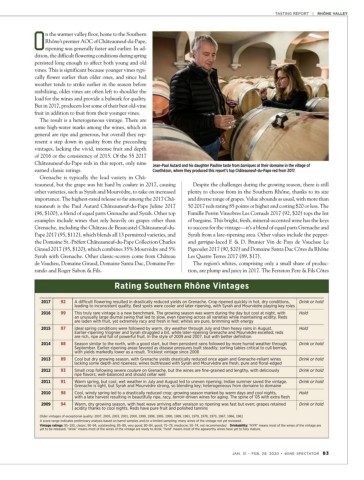
                                                                                  Jean-Paul Autard and his daughter Pauline taste from barriques at their domaine in the village of
                   earned classic ratings.                                        Courthézon, where they produced this report’s top Châteauneuf-du-Pape red from 2017.
                      Grenache is typically the lead variety in Châ-
                   teauneuf, but the grape was hit hard by coulure in 2017, causing                     Despite the challenges during the growing season, there is still

                   other varieties, such as Syrah and Mourvèdre, to take on increased                plenty to choose from in the Southern Rhône, thanks to its size
                   importance. The highest-rated release so far among the 2017 Châ-                  and diverse range of grapes. Value abounds as usual, with more than

                   teauneufs is the Paul Autard Châteauneuf-du-Pape Juline 2017                      50 2017 reds rating 85 points or higher and costing $20 or less. The
                   (96, $100), a blend of equal parts Grenache and Syrah. Other top                  Famille Perrin Vinsobres Les Cornuds 2017 (92, $20) tops the list
                   examples include wines that rely heavily on grapes other than                     of bargains. This bright, fresh, mineral-accented wine has the keys

                   Grenache, including the Château de Beaucastel Châteauneuf-du-                     to success for the vintage—it’s a blend of equal parts Grenache and
                   Pape 2017 (95, $112), which blends all 13 permitted varieties, and                Syrah from a late-ripening area. Other values include the pepper-

                   the Domaine St.-Préfert Châteauneuf-du-Pape Collection Charles                    and garrigue-laced F. & D. Brunier Vin de Pays de Vaucluse Le
                   Giraud 2017 (95, $120), which combines 35% Mourvèdre and 5%                       Pigeoulet 2017 (90, $20) and Domaine Santa Duc Côtes du Rhône
                   Syrah with Grenache. Other classic-scorers come from Château                      Les Quatre Terres 2017 (89, $17).

                   de Vaudieu, Domaine Giraud, Domaine Santa Duc, Domaine Fer-                          The region’s whites, comprising only a small share of produc-
                   rando and Roger Sabon & Fils.                                                     tion, are plump and juicy in 2017. The Ferraton Pere & Fils Côtes


                                                              Rating Southern Rhône Vintages


                       2017      92      A difficult flowering resulted in drastically reduced yields on Grenache. Crop ripened quickly in hot, dry conditions,   Drink or hold
                                         leading to inconsistent quality. Best spots were cooler and later-ripening, with Syrah and Mourvèdre playing key roles

                       2016      99      This truly rare vintage is a new benchmark. The growing season was warm during the day but cool at night, with          Hold
                                         an unusually large diurnal swing that led to slow, even ripening across all varieties while maintaining acidity. Reds
                                         are laden with fruit, yet extremely racy and fresh in feel; whites are pure, brimming with energy

                       2015      97      Ideal spring conditions were followed by warm, dry weather through July and then heavy rains in August.                 Hold
                                         Earlier-ripening Viognier and Syrah struggled a bit, while later-ripening Grenache and Mourvèdre excelled; reds
                                         are rich, ripe and full of powerful fruit. In the style of 2009 and 2007, but with better definition

                       2014      88      Season similar to the north, with a good start, but then persistent rains followed by more humid weather through        Drink or hold
                                         September. Earlier-ripening areas favored as disease pressures built steadily; sorting tables critical to cull berries,
                                         with yields markedly lower as a result. Trickiest vintage since 2008

                       2013      89      Cool but dry growing season, with Grenache yields drastically reduced once again and Grenache-reliant wines             Drink or hold
                                         lacking some depth and ripeness; wines buttressed with Syrah and Mourvèdre are fresh, pure and floral-edged

                       2012      93      Small crop following severe coulure on Grenache, but the wines are fine-grained and lengthy, with deliciously           Drink or hold
                                         ripe flavors; well-balanced and should cellar well
                       2011      91      Warm spring, but cool, wet weather in July and August led to uneven ripening; Indian summer saved the vintage.          Drink or hold
                                         Grenache is light, but Syrah and Mourvèdre strong, so blending key; heterogeneous from domaine to domaine
                       2010      98      Cool, windy spring led to a drastically reduced crop; growing season marked by warm days and cool nights,               Hold
                                         with a late harvest resulting in beautifully ripe, racy, terroir-driven wines for aging. The spine of ’05 with extra flesh
                       2009      94      Warm, dry growing season, with heat wave arriving after veraison so ripening was fast but even; grapes retained         Drink or hold
                                         acidity thanks to cool nights. Reds have pure fruit and polished tannins

                      Older vintages of exceptional quality: 2007, 2005, 2003, 2001, 2000, 1999, 1998, 1995, 1990, 1989, 1981, 1979, 1978, 1970, 1967, 1966, 1961
                      A score range indicates preliminary analysis based on barrel samples and/or a limited sampling; many wines of the vintage not yet reviewed.
                      Vintage ratings: 95–100, classic; 90–94, outstanding; 85–89, very good; 80–84, good; 75–79, mediocre; 50–74, not recommended Drinkability: “NYR” means most of the wines of the vintage are
                      yet to be released; “drink” means most of the wines of the vintage are ready to drink; “hold” means most of the ageworthy wines have yet to fully mature.


                                                                                                                             JAN.  31  -  FEB.  29,  2020  •  WINE  SPECTATOR    83

