


Page 92 - Wine Spectator (January 2020)
P. 92
cuvées sourced from his best plots and oldest vines. These

                                                                                                             11 different bottlings of Côte-Rôtie all earned scores of 93
                                                                                                             points or higher in 2015, led by the sensational Côte-Rôtie

                                                                                                             La Belle Hélène 2015 (98, $552), sourced from 65-year-old
                                                                                                             vines (Ogier’s oldest) in the Côte Rozier lieu-dit.
                                                                                                                Other late-release reds for the trophy-hunting crowd in-

                                                                                                             clude the trio of La La wines from E. Guigal: the Côte-Rôtie
                                                                                                             La Landonne 2015 (99, $525), Côte-Rôtie La Turque 2015

                                                                                                             (99, $525) and Côte-Rôtie La Mouline 2015 (98, $525). In
                                                                                                             Hermitage, the M. Chapoutier Ermitage L’Ermite 2016 (98,
                                                                                                             $565) and Jean-Louis Chave Hermitage 2016 (97, $340)

                                                                                                             are rare gems, while Cornas delivers the A. Clape Cornas
                                                                                                             2016 (98, $150), which maintains its stellar track record

                                                                                                             and provides arguably the best relative value among the
                                                                                                             region’s cellar-worthy wines. Among late-release whites,
                                                                                                             Chave’s Hermitage White 2016 (98, $340) is a stunner.

                                                                                                                With 2016 and 2015 firmly cemented as classic years,
                                                                                                             2017 looks to be the keystone in a truly special run of vin-
                                                                                                             tages, as both 2018 and 2019 appear to be exceptional as

                                                                                                             well. The 2018 vintage was another warm and dry year
                                                                                                             marred only by early mildew pressure, yielding richly lay-
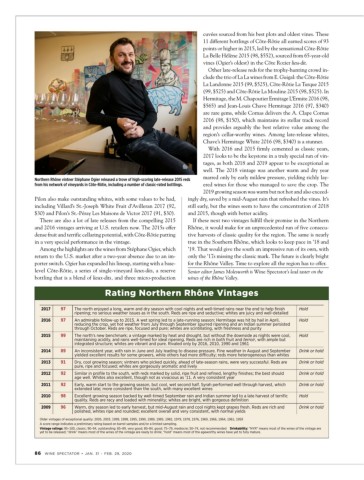
                   Northern Rhône vintner Stéphane Ogier released a trove of high-scoring late-release 2015 reds
                   from his network of vineyards in Côte-Rôtie, including a number of classic-rated bottlings.  ered wines for those who managed to save the crop. The
                                                                                                             2019 growing season was warm but not hot and also exceed-
                   Pilon also make outstanding whites, with some values to be had,                   ingly dry, saved by a mid-August rain that refreshed the vines. It’s

                   including Villard’s St.-Joseph White Fruit d’Avilleran 2017 (92,                  still early, but the wines seem to have the concentration of 2018
                   $30) and Pilon’s St.-Péray Les Maisons de Victor 2017 (91, $30).                  and 2015, though with better acidity.
                      There are also a lot of late releases from the compelling 2015                    If these next two vintages fulfill their promise in the Northern

                   and 2016 vintages arriving at U.S. retailers now. The 2015s offer                 Rhône, it would make for an unprecedented run of five consecu-
                   dense fruit and terrific cellaring potential, with Côte-Rôtie putting             tive harvests of classic quality for the region. The same is nearly

                   in a very special performance in the vintage.                                     true in the Southern Rhône, which looks to keep pace in ’18 and
                      Among the highlights are the wines from Stéphane Ogier, which                  ’19. That would give the south an impressive run of its own, with
                   return to the U.S. market after a two-year absence due to an im-                  only the ’17s missing the classic mark. The future is clearly bright

                   porter switch. Ogier has expanded his lineup, starting with a base-               for the Rhône Valley. Time to explore all the region has to offer.
                   level Côte-Rôtie, a series of single-vineyard lieux-dits, a reserve               Senior editor James Molesworth is Wine Spectator’s lead taster on the

                   bottling that is a blend of lieux-dits, and three micro-production                wines of the Rhône Valley.


                                                         Rating Northern Rhône Vintages


                       2017      97      The north enjoyed a long, warm and dry season with cool nights and well-timed rains near the end to help finish         Hold
                                         ripening; no serious weather issues as in the south. Reds are ripe and seductive; whites are juicy and well-detailed
                       2016      97      An admirable follow-up to 2015. A wet spring led to a late-running season; Hermitage was hit by hail in April,          Hold
                                         reducing the crop, yet hot weather from July through September spurred ripening and an Indian summer persisted
                                         through October. Reds are ripe, focused and pure; whites are scintillating, with freshness and purity
                       2015      99      The north’s new benchmark; a vintage marked by heat and drought, but without the downside as nights were cool,          Hold
                                         maintaining acidity, and rains well-timed for ideal ripening. Reds are rich in both fruit and terroir, with ample but
                                         integrated structure; whites are vibrant and pure. Rivaled only by 2016, 2010, 1990 and 1961
                       2014      89      An inconsistent year, with rain in June and July leading to disease pressure. Fine weather in August and September      Drink or hold
                                         yielded excellent results for some growers, while others had more difficulty; reds more heterogeneous than whites
                       2013      91      Dry, cool growing season; vintners who picked quickly, ahead of late-season rains, were very successful. Reds are       Drink or hold
                                         pure, ripe and focused; whites are gorgeously aromatic and lively

                       2012      92      Similar in profile to the south, with reds marked by solid, ripe fruit and refined, lengthy finishes; the best should    Drink or hold
                                         age well. Whites also excellent, though not as vivacious as ’11. A very consistent year
                       2011      92      Early, warm start to the growing season, but cool, wet second half. Syrah performed well through harvest, which         Drink or hold
                                         extended late; more consistent than the south, with many excellent wines
                       2010      98      Excellent growing season backed by well-timed September rain and Indian summer led to a late harvest of terrific        Hold
                                         quality. Reds are racy and loaded with minerality; whites are bright, with gorgeous definition

                       2009      96      Warm, dry season led to early harvest, but mid-August rain and cool nights kept grapes fresh. Reds are rich and         Drink or hold
                                         polished, whites ripe and rounded; excellent overall and very consistent, with normal yields

                      Older vintages of exceptional quality: 2005, 2003, 1999, 1998, 1995, 1990, 1989, 1985, 1982, 1979, 1978, 1976, 1969, 1966, 1964, 1961, 1959
                      A score range indicates a preliminary rating based on barrel samples and/or a limited sampling.
                      Vintage ratings: 95–100, classic; 90–94, outstanding; 85–89, very good; 80–84, good; 75–79, mediocre; 50–74, not recommended Drinkability: “NYR” means most of the wines of the vintage are
                      yet to be released; “drink” means most of the wines of the vintage are ready to drink; “hold” means most of the ageworthy wines have yet to fully mature.


                   86    WINE  SPECTATOR  •  JAN.  31  -  FEB.  29,  2020

