


Page 88 - Wine Spectator (January 2020)
P. 88
2017 and the Northern Rhône at 97 points. Late-release

                   2016s and early-release 2018s make up most of the remain-                                                            GRIGNAN          SOUTHERN
                   der,  along  with  a  handful  of  older  bottlings.  (A  free                                                          LES
                                                                                                                                        ADHÉMAR
                   alphabetical list of scores and prices for all wines tasted is                                                                            RHÔNE
                                                                                                CÔTES DU
                   available at WineSpectator.com/ RhoneAlpha022920.)                            VIVARAIS


                                                                                                                                        VALRÉAS
                   The Southern Rhône
                                                                                                                                                                 VINSOBRES
                                                                                                                                       VISAN
                         he 2017 growing season was marked by a severe spring
                         frost that affected many of France’s winegrowing ar-                                                    ROCHEGUDE       RASTEAU       ROAIX

                   T eas. The frost nicked parts of the Ventoux and Côtes
                                                                                                                                      CAIRANNE              SÉGURET
                   du Rhône in the Southern Rhône, but the major AOCs                                       ST.-GERVAIS             GIGONDAS                  SABLET

                   were not impacted. The real hiccup for the south in 2017                                                                                        CÔTES DU
                                                                                                                CHUSCLAN       VACQUEYRAS        VIOLÈS              RHÔNE
                   was the hot and windy weather during the flowering.
                                                                                                                                  COURTHEZON
                      “2017 in the south was a very low crop, because of a bad                                  LAUDUN
                                                                                                                                                              BEAUMES-
                   flowering that really affected the Grenache,” says Louis                                                                     SARRIANS      DE-VENISE
                   Barruol of Château de St.-Cosme in Gigondas. “The wines                                               LIRAC             CHÂTEAUNEUF-
                   are intense but a touch square or austere. They lack a touch                                         TAVEL                  DU-PAPE   CÔTES DU

                   of roundness for real balance. But as with ’13, I think they                                         ROQUEMAURE                       VENTOUX
                   will be good with a little bit of time. I like low yields, but                        ESTÉZARGUES                    AVIGNON
                   too low and it gets a little rustic because grapes ripen

                   quickly with low yields. Things need to ripen slowly.”
                                                                                                      COSTIÈRES
                      After the flowering, warm and dry conditions persisted                           DE NÎMES                                  La Durance
                                                                                              NÎMES
                   through the summer, so ripening was sped up and uneven.                                                                                      CÔTES DU
                                                                                                                                                                LUBERON
                   In some areas, blockages resulted in rustic tannins. Har-                                     BELLEGARDE
                   vest started two weeks early on average for most estates.                                                        FRANCE

                      Gigondas, however, experienced slower and later ripen-
                   ing, with the area’s cooler elevation acting as a moderat-                                                              AREA OF
                                                                                                                                           DETAIL
                   ing influence on the valley’s warm temperatures. When                                           CÔTES DU
                                                                                                                      RHÔNE                                 N
                   late-season storms threatened, some producers chose to                                          VILLAGES
                                                                                                                                                         0 miles            10
                   pick early, while others gambled by waiting. That’s where
                   the vintage was made.
                      “We decided to wait before picking,” says Benjamin

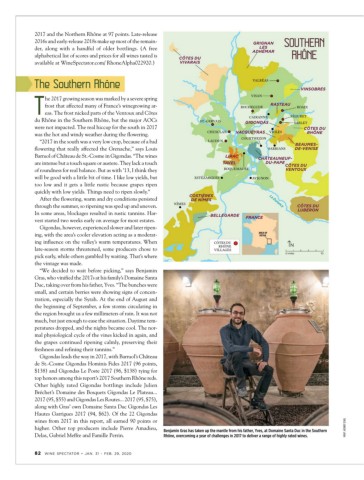
                   Gras, who vinified the 2017s at his family’s Domaine Santa
                   Duc, taking over from his father, Yves. “The bunches were
                   small, and certain berries were showing signs of concen-

                   tration, especially the Syrah. At the end of August and
                   the beginning of September, a few storms circulating in

                   the region brought us a few millimeters of rain. It was not
                   much, but just enough to ease the situation. Daytime tem-
                   peratures dropped, and the nights became cool. The nor-

                   mal physiological cycle of the vines kicked in again, and
                   the grapes continued ripening calmly, preserving their

                   freshness and refining their tannins.”
                      Gigondas leads the way in 2017, with Barruol’s Château
                   de St.-Cosme Gigondas Hominis Fides 2017 (96 points,

                   $138) and Gigondas Le Poste 2017 (96, $138) tying for
                   top honors among this report’s 2017 Southern Rhône reds.
                   Other  highly  rated  Gigondas  bottlings  include  Julien

                   Bréchet’s Domaine des Bosquets Gigondas Le Plateau...
                   2017 (95, $55) and Gigondas Les Routes... 2017 (95, $75),
                   along with Gras’ own Domaine Santa Duc Gigondas Les

                   Hautes Garrigues 2017 (94, $62). Of the 22 Gigondas
                   wines from 2017 in this report, all earned 90 points or

                   higher.  Other  top  producers  include  Pierre  Amadieu,                                                                                                             MAP: HENRY ENG
                                                                                        Benjamin Gras has taken up the mantle from his father, Yves, at Domaine Santa Duc in the Southern
                   Delas, Gabriel Meffre and Famille Perrin.                            Rhône, overcoming a year of challenges in 2017 to deliver a range of highly rated wines.


                   82    WINE  SPECTATOR  •  JAN.  31  -  FEB.  29,  2020

