


Page 100 - (DK Eyewitness) Travel Guide - Hungary
P. 100
98 BUD APEST AREA B Y AREA
marble and bronze; ceiling
stucco-work in Louis XIV style;
chandeliers, lamps and Secession-
style chairs brought from Paris.
A tempting selection of frothy
coffees, cakes, pastries and
desserts is on offer. In summer,
refreshments can be taken on a
terrace over looking the square.
3 Turkish Bank
Török Bankház
Szervita tér 3. Map 4 D1.
q Deák Ferenc tér.
Dating from 1906 and designed
by Henrik Böhm and Ármin
Hegedűs, the building that
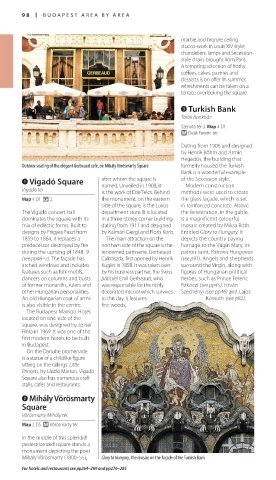
Outdoor seating of the elegant Gerbeaud café, on Mihály Vörösmarty Square formerly housed the Turkish
Bank is a wonder ful example
1 Vigadó Square after whom the square is of the Secession style.
Vigadó tér named. Unveiled in 1908, it Modern construction
is the work of Ede Telcs. Behind methods were used to create
Map 4 D1. v 2. the monument, on the eastern the glass façade, which is set
side of the square, is the Luxus in reinforced concrete. Above
The Vigadó concert hall depart ment store. It is located the fenestration, in the gable,
dominates the square with its in a three-storey corner building is a magnificent colourful
mix of eclectic forms. Built to dating from 1911 and designed mosaic created by Miksa Róth.
designs by Frigyes Feszl from by Kálmán Giergl and Flóris Korb. Entitled Glory to Hungary, it
1859 to 1864, it replaces a The main attraction on the depicts the country paying
predecessor destroyed by fire northern side of the square is the homage to the Virgin Mary, its
during the uprising of 1848–9 renowned patisserie, Gerbeaud patron saint, Patrona Hungariae
(see pp46–7). The façade has Cukrászda, first opened by Henrik (see p91). Angels and shepherds
arched windows and includes Kugler in 1858. It was taken over surround the Virgin, along with
features such as folk motifs, by his business partner, the Swiss figures of Hungarian political
dancers on columns and busts pâtissier Emil Gerbeaud, who heroes, such as Prince Ferenc
of former monarchs, rulers and was responsible for the richly Rákóczi (see pp45), István
other Hungarian personalities. decorated interior which survives Széchenyi (see pp46) and Lajos
An old Hungarian coat of arms to this day. It features Kossuth (see p82).
is also visible in the centre. fine woods,
The Budapest Marriott Hotel,
located on one side of the
square, was designed by József
Finta in 1969. It was one of the
first modern hotels to be built
in Budapest.
On the Danube promenade
is a statue of a childlike figure
sitting on the railings: Little
Princess, by László Marton. Vigadó
Square also has numerous craft
stalls, cafés and restaurants.
2 Mihály Vörösmarty
Square
Vörösmarty Mihály tér
Map 2 D5. q Vörösmarty tér.
In the middle of this splendid
pedestrianized square stands a
monument depicting the poet
Mihály Vörösmarty (1800–55), Glory to Hungary, the mosaic on the façade of the Turkish Bank
For hotels and restaurants see pp264–269 and pp276–285
098-099_EW_Hungary.indd 98 18/09/17 3:37 pm

