


Page 101 - (DK Eyewitness) Travel Guide - Hungary
P. 101
CENTR AL PEST 99
4 Pest County Hall In a side street off Váci Street,
Pest Megyei Önkormányzat at No. 13 Régiposta utca, stands
Városház utca 7. Map 4 E1. Tel (1) 485 a Modernist-style building.
68 00 or 485 68 26. q Ferenciek tere. An unusual sight in Pest, this
Open 8am–6pm Mon–Fri. Bauhaus-influenced building
dates from 1937 and is by
Built in several stages, this is Lajos Kozma.
one of Pest’s most beautiful,
monumental Neo-Classical civic 6 Inner City Parish
buildings. It was erected during Church
the 19th century, as part of the
plan for the city drawn up by the Belvárosi Plébánia templom
Embellish ment Commission. Március 15 tér 2. Map 4 D1. Tel (1) 318
A seat of the Council of 31 08. q Ferenciek tere. Open 9am–
Pest has existed on this site 6pm daily.
since the late 17th century. By
1811, the building comprised Thonet House, with Zsolnay tile decoration, The oldest building in Pest, this
two conference halls, a prison at No. 11 Váci Street church was first established during
and a prison chapel. Between the reign of St István, on the burial
1829 and 1832, a wing designed 20th centuries. More recently, site of the martyred St Gellért. In
by József Hofrichter was added however, modern department the 12th century it was replaced
on Semmelweis utca. stores, banks and shopping by a Romanesque church, of
In another development arcades have sprung up along which a wall fragment remains in
phase, in 1838–42, Mátyás the street among the older the façade of the South Tower.
Zitterbarth Jr com pleted the original buildings. In the 14th century it became
impressive façade, which over- Philantia, a a large Gothic
looks Városház utca. It features Secession-style construction, and
a portico with six Corinthian florist’s shop opened subse quently a
columns that support a in 1905, now mosque. Damaged by
prominent tympanum. occupies part of the the Great Fire of 1723,
County Hall was rebuilt and Neo-Classical block the church was partly
enlarged after destruction at No. 9, built in 1840 rebuilt in the Baroque
during World War II. Three by József Hild. No. 9 style by György Paur
internal courtyards were added. also houses the Pest in 1725–39. The interior
The first of these is surrounded Theatre, where classic Crest of Pest in Inner City also contains Neo-
by cloisters; summer concerts plays by Anton Parish Church Classical elements by
are often held here. Chekhov, among János Hild, as well as
In the small adjoining street, others, are staged. The building 20th-century works. The main altar
Kamer mayer Károly tér, stands was once occupied by the “Inn (1948) is one such piece, replacing
an aluminium monument, of the Seven Electors”, which the original. It was painted by
designed in 1942 by Béla had a large ballroom and Károly Antal and Pál Molnár.
Szabados, to Buda pest’s first concert hall. It was here that a The church is open, although
mayor, Károly Kamermayer 12-year-old Ferenc (Franz) Liszt ongoing renovations may
(1829–97), who took office in performed in 1823. affect visitors.
1873 after the unifi cation of Thonet House, at No. 11, is
Óbuda, Buda and Pest. most notable for the Zsolnay
tiles from Pécs that adorn its
5 Váci Street façade. No. 13 is the oldest
building on Váci Street and
Váci utca was built in 1805. In contrast,
Map 4 D1–E2. q Ferenciek tere. the Post-Modern Fontana
department store at No. 16 was
Once two separate streets, which built in 1984. Outside there is a
were joined at the beginning of bronze fountain with a figure of
the 18th century, the two ends the Greek god Hermes, dating
of Váci Street still have distinct from the mid-19th century.
characters, the northern end The Nádor Hotel once stood
being perhaps the more at No. 20 and featured a statue
elegant. The whole street is of Archduke Palatine József in
pedestrianized, making this front of the entrance. Today
a popular visitor destination for the Taverna Hotel, designed
shopping and strolling. Most of by József Finta and opened
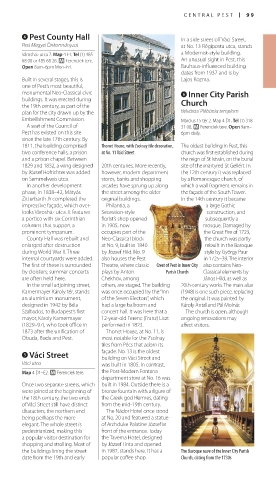
the buildings lining the street in 1987, stands here. It has a The Baroque nave of the Inner City Parish
date from the 19th and early popular coffee shop. Church, dating from the 1730s
098-099_EW_Hungary.indd 99 18/09/17 3:37 pm

