


Page 103 - (DK Eyewitness) Travel Guide - Hungary
P. 103
CENTR AL PEST 101
q Museum of
Applied Arts
Iparművészeti Múzeum
Űllői út 33–37. Map 4 F2. Tel (1) 456
51 07. q Ferenc körút. Open
10am–6pm Tue–Sun. & = -
∑ imm.hu
The Museum of Applied
Arts was opened in 1896 by
Emperor Franz Joseph as part
of the Millennium Celebrations
(see p108). The collection is
housed not within a Neo-
Classical building, but within an
outstanding Secession building
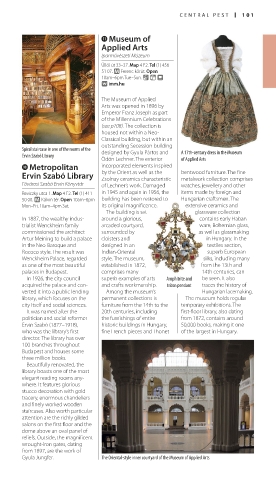
Spiral staircase in one of the rooms of the
Ervin Szabó Library designed by Gyula Pártos and A 17th-century dress in the Museum
Ödön Lechner. The exterior of Applied Arts
0 Metropolitan incorporated elements inspired
Ervin Szabó Library by the Orient as well as the bentwood furniture. The fine
Zsolnay ceramics characteristic
metalwork collection com prises
Fövárosi Szabó Ervin Könyvtár of Lechner’s work. Damaged watches, jewellery and other
Reviczky utca 1. Map 4 F2. Tel (1) 411 in 1945 and again in 1956, the items made by foreign and
50 00. q Kálvin tér. Open 10am–8pm building has been restored to Hungarian craftsmen. The
Mon–Fri, 10am–4pm Sat. its original magnificence. extensive ceramics and
The building is set glass ware collection
In 1887, the wealthy indus- around a glorious, contains early Haban
trialist Wenckheim family arcaded courtyard, ware, Bohemian glass,
com missioned the architect surrounded by as well as glass making
Artur Meining to build a palace cloisters and in Hungary. In the
in the Neo-Baroque and designed in an textiles section,
Rococo style. The result was Indian-Oriental superb European
Wenck heim Palace, regarded style. The museum, silks, including many
as one of the most beautiful established in 1872, from the 13th and
palaces in Budapest. comprises many 14th centuries, can
In 1926, the city council superb examples of arts Amphitrite and be seen. It also
acquired the palace and con- and crafts workmanship. triton pendant traces the history of
verted it into a public lending Among the museum’s Hungarian lace making.
library, which focuses on the permanent collections is The museum holds regular
city itself and social sciences. furniture from the 14th to the temporary exhibitions. The
It was named after the 20th centuries, including first-floor library, also dating
politician and social reformer the furnishings of entire from 1872, contains around
Ervin Szabó (1877–1918), historic buildings in Hungary, 50,000 books, making it one
who was the library’s first fine French pieces and Thonet of the largest in Hungary.
director. The library has over
100 branches through out
Buda pest and houses some
three million books.
Beautifully renovated, the
library boasts one of the most
elegant reading rooms any-
where. It features glorious
stucco decoration with gold
tracery, enormous chandeliers
and finely worked wooden
staircases. Also worth particular
attention are the richly gilded
salons on the first floor and the
dome above an oval panel of
reliefs. Outside, the magnificent
wrought-iron gates, dating
from 1897, are the work of
Gyula Jungfer. The Oriental-style inner courtyard of the Museum of Applied Arts
100-101_EW_Hungary.indd 101 14/11/2017 16:48

