Page 104 - (DK Eyewitness) Travel Guide - Hungary
P. 104
102      BUD APEST  AREA  B Y  AREA                                                                           CENTR AL  PEST      103

       w Hungarian National Museum                                                       Right Hand of Stalin
                                                                                This hand is all that remains of the 8-m-   VISITORS’ CHECKLIST
                                                                               (26-ft-) high statue of Stalin that stood in
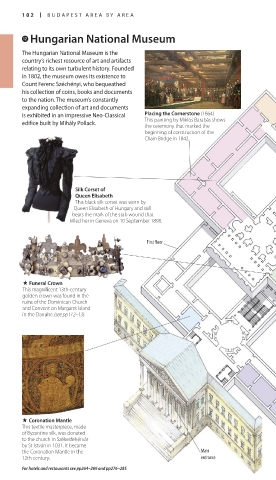
       The Hungarian National Museum is the                                   the Városliget in Budapest. A symbol     Practical Information
       country’s richest resource of art and artifacts                           of the Communist regime,              Múzeum körút 14–16. Map 4 E1/
       relating to its own turbulent history. Founded                           the statue was destroyed               F1. Tel (1) 338 21 22 (327 77 73
                                                                                                                       for guided tours in English).
                                                                                   in the Hungarian
       in 1802, the museum owes its existence to                                 Revolution of 1956.                   Open 10am–6pm Tue–Sun. &
       Count Ferenc Széchényi, who bequeathed                                                                          8 - = ∑ mnm.hu
       his collection of coins, books and documents                                                                    Transport
       to the nation. The museum’s constantly                                                                          v 47, 49. q Kálvin tér, Astoria.
       expanding collection of art and documents                                                                       @ 9, 15.
       is exhibited in an impressive Neo-Classical   Placing the Cornerstone (1864)
       edifice built by Mihály Pollack.  This painting by Miklós Barabás shows
                                      the ceremony that marked the
                                      beginning of construction of the
                                      Chain Bridge in 1842.
                                                                                                                         Pelisse
                                                                                             Second floor
                                                                                                                           This short jacket, dating
                                                                                                                            from around 1620, is
                                                                                                                             typical of Hungarian
                                                                                                                              national costume. It
                                                                                                                               belonged to Gábor
                                                                                                                               Bethlen, a prince
                    Silk Corset of                                                                                              of Transylvania.
                    Queen Elisabeth
                    This black silk corset was worn by
                    Queen Elisabeth of Hungary and still
                    bears the mark of the stab wound that
                   killed her in Geneva on 10 September 1898.
                                       First floor


                                                                                                                Gothic Well
       . Funeral Crown                                                                              These reconstructed fragments are
       This magnificent 13th-century                                                                   part of a well from the Royal
       golden crown was found in the                                                                 Palace at Visegrád. The well dates
       ruins of the Dominican Church                                                                 from the 14th-century rule of the
       and Convent on Margaret Island                                                                        Angevin dynasty.
       in the Danube (see pp112–13).
                                                                                                  Museum Guide
                                                                                                  On the first floor is the Coronation
                                                                                                  Mantle and the archaeological
                                                                                                exhibition. Second-floor exhibits
                                                                                              comprise Hungarian artifacts from the
                                                                                             11th to the 20th centuries. The lapidaries are
                                                                                           on the ground floor and in the basement.


                                                                                                                       Key
       . Coronation Mantle                                                                             . Golden Stag
       This textile masterpiece, made                                                                 This hand-forged Iron      Coronation Mantle
       of Byzantine silk, was donated                                                                  Age figure dates from      Archaeological exhibition
       to the church in Székesfehérvár                                                                  the 6th century BC.       11th- to 17th-century exhibition
       by St István in 1031. It became                                                                   It was originally
       the Coronation Mantle in the                  Main                                                 part of a Scythian      18th- to 19th-century exhibition
       12th century.                                 entrance                                             prince’s shield.     20th-century exhibition
       For hotels and restaurants see pp264–269 and pp276–285


   Hun_102-103_SS.indd   102                                 17/02/2015   12:55  Hun_102-103_SS.indd   103                          17/02/2015   12:55
   99   100   101   102   103   104   105   106   107   108   109