


Page 116 - (DK Eyewitness) Travel Guide - Hungary
P. 116
114 BUD APEST AREA B Y AREA FUR THER AFIELD 115
e Buda Hills
community. At the end of
the 19th century, nearly a Budai-hegység
quarter of the city’s inhabit ants q Széll Kálmán tér, then v 56, then
were Jewish. Tombs to look cog-wheel railway and chair lift.
out for as you stroll among
the graves include that of the To the west of the city centre
Wellisch family, designed in are the wooded Buda Hills.
1903 by Arthur Wellisch, and There are many caves here,
that of Konrád Polnay, which including Szemlőhegyi and
was designed five years later Pálvölgyi-barlang.
by Gyula Fodor. Perhaps the The first station of a
most eye catching of all tombs cog- wheel railway, built in
belongs to the Schmidl family. 1874, is on Szilágyi Erzsébet
The startlingly flamboyant fasor. This runs up Sváb Hill –
edifice, designed in 1903 named after the Germanic
by Hungary’s prominent Foyer in the Palace of Arts, a multi-arts performance venue Swabians, who settled here
architects Ödön Lechner and under the Habsburgs (see pp44–5)
Béla Lajta, is covered in vivid q Palace of Arts fence of the wild and craggy – and then Széchenyi Hill.
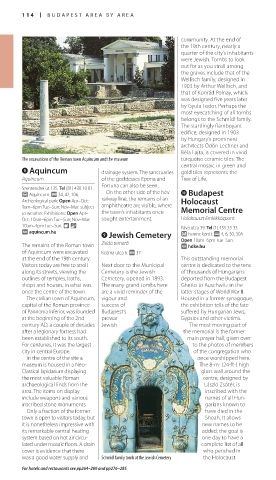
The excavations of the Roman town Aquincum and the museum turquoise ceramic tiles. The (MÜPA) 300-sq-m (360-sq-yd) reserve From Széchenyi Hill a
central mosaic in green and Művészetek Palotája that it encloses. It is worth taking narrow-gauge railway covers
8 Aquincum drainage system. The sanctuaries gold tiles represents the the guided walk in the reserve, a 12-km (7-mile) route to the
Aquincum of the goddesses Epona and Tree of Life. Komor Marcell utca 1. v 1, 2, 2A, 24. parti cularly in spring or early Hűvös Valley. As in the days
Fortuna can also be seen. Ticket office (for all events): Tel (1) 555 autumn. This is one of the only of the Soviet Young Pioneers
Szentendrei út 135. Tel (81) 430 10 81. 33 00 or online. Open 10am–6pm
£ Aquincum. @ 34, 42, 106. On the other side of the hév 0 Budapest daily. 8 ∑ mupa.hu Museum of places to see the endangered movement, the railway is staffed
Archeological park: Open Apr–Oct: railway line, the remains of an Holocaust Contemporary Art: Tel (1) 555 34 44. Centaurea sadleriana, a flower by children, apart from the adult
9am–6pm Tue–Sun; Nov–Mar: subject amphi theatre are visible, where Memorial Centre Open 10am–8pm Tue–Sun. that resembles a cornflower but train drivers. At the top of János
to weather. Exhibitions: Open Apr– the town’s inhabitants once ∑ ludwigmuseum.hu with a much larger flower head. Hill stands the Erzsébet Look-
Oct: 10am–6pm Tue–Sun; Nov–Mar: sought entertainment. Holokauszt Emlékközpont The reserve is also home to a Out Tower, designed by Frigyes
10am–4pm Tue–Sun. 8 & Páva utca 39. Tel (1) 455 33 33. The Palace of Arts, located in the blue grass and a spider found Schulek in 1910. A chair lift
∑ aquincum.hu Millennium City Centre on the Pest nowhere else in the world, as connects János Hill with
9 Jewish Cemetery q Ferenc körút. @ 4, 6, 30, 30A. side of the Danube, between well as extra ordinary, colourful Zugligeti út and this is a good
The remains of the Roman town Zsidó temető Open 10am–6pm Tue–Sun. Lágymányos Bridge and the butterflies and a rare lizard. way of making the descent.
∑ hdke.hu
of Aquincum were excavated Kozma utca 6. @ 37. new National Theatre, brings
at the end of the 19th century. This outstanding memorial together all the arts under one
Visitors today are free to stroll Next door to the Municipal centre is dedicated to the tens roof. Permanent residents in
along its streets, viewing the Cemetery is the Jewish of thousands of Hungarians the palace include the Ludwig
outlines of temples, baths, Cemetery, opened in 1893. deported from the Budapest Museum of Con tem porary Art,
shops and houses, in what was The many grand tombs here Ghetto to Auschwitz in the the Béla Bartók National Concert
once the centre of the town. are a vivid reminder of the latter stages of World War II. Hall, the Festival Theatre and the
The civilian town of Aquincum, vigour and Housed in a former synagogue, National Dance Theatre.
capital of the Roman province success of the exhibition tells of the fate
of Pannonia Inferior, was founded Budapest’s suffered by Hungarian Jews, w Eagle Hill Nature
at the beginning of the 2nd prewar Gypsies and other victims. Reserve
century AD, a couple of decades Jewish The most moving part of
after a legionary fortress had the memorial is the former Sas-hegy Természetvédelmi Terület
been established to its south. main prayer hall, given over Tájék utca 26. Tel (30) 477 67 20, (30)
For centuries, it was the largest to the photos of members 408 43 70. @ 8, 8A. Open 10am–6pm
city in central Europe. of the congregation who Tue, Fri–Sun & pub hols, or by
In the centre of the site a once worshipped here. arrangement. 8 compulsory.
museum is housed in a Neo- The 8-m- (24-ft-) high
Classical lapidarium displaying glass wall around the A nature reserve such as
the most valuable Roman centre, designed by this that is close to the
archaeological finds from the László Zsótér, is centre of a large city is a
area. The items on display inscribed with the remark able phenomenon.
include weapons and various names of all Hun- Access to the summit of
inscribed stone monuments. garians known to this steep, 266-m- (872-ft-)
Only a fraction of the former have died in the high hill to the west of Gellért
town is open to visitors today, but Shoah. It allows Hill (see pp73) is strictly regulated
it is nonetheless impressive with new names to be to protect the extremely rare
its remarkable central heating added; the goal is animal and plant species found
system based on hot air circu- one day to have a here. A smart residential quar ter
lated under mosaic floors. A drain complete list of all of attractive bourgeois villas,
cover is evidence that there who perished in which lies on the lower slope of
was a good water supply and Schmidl family tomb at the Jewish Cemetery the Holocaust. Eagle Hill, extends almost to the The Erzsébet Look-Out Tower at the summit of János Hill, Buda Hills
For hotels and restaurants see pp264–269 and pp276–285
114-115_EW_Hungary.indd 114 18/09/17 3:39 pm 114-115_EW_Hungary.indd 115 18/09/17 3:39 pm

