


Page 112 - (DK Eyewitness) Travel Guide - Hungary
P. 112
110 BUD APEST AREA B Y AREA FUR THER AFIELD 111
1 St Anne’s Church City Park was the centre for the
Szent Anna templom 1896 Millennium Cele brations
Batthyány tér 7. Map 1 B4. Tel (1) 201 (see p108), when the Museum
34 04. q Batthyány tér. Open Only of Fine Arts, Vajda hunyad
for services. 5 daily. Angelika Café: Castle and the Heroes’ Square
Open 9am–12pm daily. Monu ment were built.
Today, attractions include a
Budapest is home to many lake – an ice rink in winter and
churches, but the twin-towered a boating lake in summer –
Baroque parish church of the overlooked by a Secession
Víziváros district is one of Pavilion. The park is also home
the finest. Begun in 1740 by Kristóf to the Széchenyi Baths, Buda-
Hamon and completed after his pest’s zoo and Gundel Restau- One of the outdoor pools at the beautiful Széchenyi Baths
death by Mátyás Nepauer, it was A magnificently decorated ceiling at the Museum of Fine Arts rant, which opened in 1910 and
seri ously damaged by an earth- where the Gundel palacsinta, a The pavilions are grouped cattle-breeding, wine making,
quake in 1763. The dissolution enriched by donations and 3 Műcsarnok pancake, was invented. chrono logically by style, with hunting and fishing.
of the Jesuit order – which had acquisitions, and in 1906 it Palace of Art individual styles linked together
com missioned it – further moved to its present location, Műcsarnok 5 Vajdahunyad to give the impression of a
delayed completion. It remained a stunning Neo-Classical single, cohesive design. Each 6 Széchenyi Baths
unconsecrated until 1805. building with Italian Renais- Dózsa György út 37. Tel (1) 460 70 00. Castle of the pavilions uses authentic Széchenyi Strandfürdő
The church’s façade features sance influences designed q Hősök tere. Open 10am–6pm Vajdahunyadvár details copied from Hungary’s Állatkerti körút 11. v 72. Tel (1) 363
Buda’s coat of arms on the by Fülöp Herzog and Albert Tue–Sun, noon–8pm Thu. & 7 8 Városliget. Tel (1) 363 19 73. q most important historic build- 32 10. q Széchenyi fürdő. Swimming
tympanum, set between Schickedanz. The tympanum ∑ mucsarnok.hu Széchenyi fürdő. v 70, 72, 75, 79. ings or is a looser interpretation pool: Open 6am–10pm daily; Thermal
the magnificent Baroque crowning the portico is @ 4, 20, 30. Museum of Agriculture: of a style inspired by a specific pool: Open 6am–7pm daily. &
spires. Inside, the High Altar supported by eight Corinthian Situated on the southern side Tel (1) 363 11 17. Open Mid-Mar– architect of that period. The ∑ spasbudapest.hu
(1773) depicts Mary as a child columns. It depicts the Battle of Heroes’ Square, opposite mid-Oct: 10am–5pm Tue–Sun; mid- complex reflects more than
with St Anne, her mother. of the Centaurs and Lapiths, the Museum of Fine Arts, is Oct–mid-Mar: 10am–4pm Tue–Fri, 20 of Hungary’s most renowned A statue stands at the main
and is copied from the Temple Műcsarnok (Kunsthalle), the 10am–5pm Sat & Sun. & 7 8 buildings. The medieval period, entrance to the Széchenyi
of Zeus at Olympia, Greece. largest exhibition space in all of ∑ mmgm.hu often considered a glorious time Baths, depicting geologist
The museum’s collection Hungary. Temporary exhibitions in Hungary’s history, is emph- Vilmos Zsigmondy, who
encompasses a wide range of of mainly contemporary painting This fairytale-like building is asized, while the controversial discovered a hot spring here
art from antiquity to the 20th and sculpture are held here. located among the trees at the Habs burg era is not. while drilling a well in 1879.
century. Among the exhibition Designed by Albert edge of the lake in Városliget. The Romanesque complex The Széchenyi Baths are
of Egyptian artifacts, most of Schicke danz and Fülöp Not a genuine castle but a features a copy of the portal among the deepest and hottest
which were unearthed by Herzog in 1895, the complex of buildings reflecting from a church in Ják (see p109) in Budapest – the water reaches
Hungarian archaeo logists imposing Neo-Classical various architectural styles, it as well as a monastic cloister the surface at a temperature
during 19th-century building is fronted by was designed by Ignác Alpár and palace. The details on of 74–5° C (165° F). The springs,
excavations, the a vast six-columned for the 1896 Millennium the Gothic pavilion are taken rich in minerals, are known for
collection of bronze portico. The mosaic, Celebrations (see p108). from castles such as that in their alleged healing properties
figures from the New depicting St István as Alpár’s creation illustrated Segesvár (now in Romania). and are recommended for
Kingdom of Ptolemy is the patron saint of fine the history of architecture in The architect Fischer von Erlach treating rheumatism and
the most fascinating. The art, was added to the Hungary. Originally intended inspired the Renaissance and dis orders of the nervous system,
collection of Greek vases tympanum in 1938–41. as temporary exhibition Baroque complex. The façade joints and muscles. The spa,
is the highlight of the Behind the portico is pavilions, the castle proved copies part of the Bakócz housed in a Neo-Baroque
High Altar in St Anne’s Church, one of classical arti facts, along Grimani jug, a fresco by Lajos Deák- so popular with the public chapel in the Eszter gom building by Gyõzõ Czigler and
Károly Bebo’s finest works with the famous Grimani Museum of Fine Arts Ébner in three parts that, between 1904 and cathedral (see pp148–9). Ede Dvorzsák, was constructed
jug, which dates from entitled The Beginning 1906, it was rebuilt The Museum of Agriculture, in 1909–13. In 1926, three
the 5th century BC. of Sculpture, The Source of Arts using brick to create a in the Baroque section, has open-air swimming pools
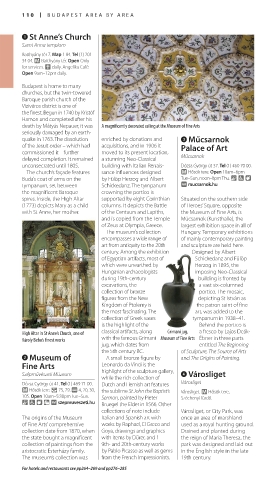
2 Museum of A small bronze figure by and The Origins of Painting. permanent structure. interesting exhibits on were added. These are popular
Fine Arts Leonardo da Vinci is the all year round due to their high
Szépművészeti Múzeum highlight of the sculpture gallery, 4 Városliget water temperatures.
while the rich collection of
Dózsa György út 41. Tel (1) 469 71 00. Dutch and Flemish art features Városliget
q Hősök tere. v 75, 79. @ 4, 20, 30, the sublime St John the Baptist’s Városliget. q Hősök tere,
105. Open 10am–5:30pm Tue–Sun. Sermon, painted by Pieter Széchenyi fürdő.
& 7 8 = ∑ szepmuveszeti.hu Bruegel the Elder in 1566. Other
collections of note include Városliget, or City Park, was
The origins of the Museum Italian and Spanish art with once an area of marshland
of Fine Arts’ comprehensive works by Raphael, El Greco and used as a royal hunting ground.
collection date from 1870, when Goya, drawings and graphics Drained and planted during
the state bought a magnificent with items by Dürer, and 1 the reign of Maria Theresa, the
collection of paintings from the 9th- and 20th-century works park was designed and laid out
aristocratic Esterházy family. by Pablo Picasso as well as gems in the English style in the late
The museum’s collection was from the French Impressionists. 19th century. View across the lake of the Gothic (left) and Renaissance (right) sections of Vajdahunyad Castle
For hotels and restaurants see pp264–269 and pp276–285
110-111_EW_Hungary.indd 110 18/09/17 3:39 pm 110-111_EW_Hungary.indd 111 18/09/17 3:39 pm

