


Page 113 - (DK Eyewitness) Travel Guide - Hungary
P. 113
FUR THER AFIELD 111
City Park was the centre for the
1896 Millennium Cele brations
(see p108), when the Museum
of Fine Arts, Vajda hunyad
Castle and the Heroes’ Square
Monu ment were built.
Today, attractions include a
lake – an ice rink in winter and
a boating lake in summer –
overlooked by a Secession
Pavilion. The park is also home
to the Széchenyi Baths, Buda-
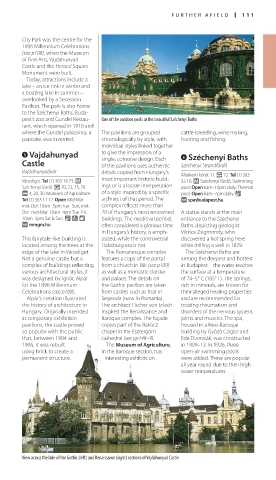
pest’s zoo and Gundel Restau- One of the outdoor pools at the beautiful Széchenyi Baths
rant, which opened in 1910 and
where the Gundel palacsinta, a The pavilions are grouped cattle-breeding, wine making,
pancake, was invented. chrono logically by style, with hunting and fishing.
individual styles linked together
5 Vajdahunyad to give the impression of a 6 Széchenyi Baths
Castle single, cohesive design. Each Széchenyi Strandfürdő
of the pavilions uses authentic
Vajdahunyadvár details copied from Hungary’s Állatkerti körút 11. v 72. Tel (1) 363
Városliget. Tel (1) 363 19 73. q most important historic build- 32 10. q Széchenyi fürdő. Swimming
Széchenyi fürdő. v 70, 72, 75, 79. ings or is a looser interpretation pool: Open 6am–10pm daily; Thermal
@ 4, 20, 30. Museum of Agriculture: of a style inspired by a specific pool: Open 6am–7pm daily. &
Tel (1) 363 11 17. Open Mid-Mar– architect of that period. The ∑ spasbudapest.hu
mid-Oct: 10am–5pm Tue–Sun; mid- complex reflects more than
Oct–mid-Mar: 10am–4pm Tue–Fri, 20 of Hungary’s most renowned A statue stands at the main
10am–5pm Sat & Sun. & 7 8 buildings. The medieval period, entrance to the Széchenyi
∑ mmgm.hu often considered a glorious time Baths, depicting geologist
in Hungary’s history, is emph- Vilmos Zsigmondy, who
This fairytale-like building is asized, while the controversial discovered a hot spring here
located among the trees at the Habs burg era is not. while drilling a well in 1879.
edge of the lake in Városliget. The Romanesque complex The Széchenyi Baths are
Not a genuine castle but a features a copy of the portal among the deepest and hottest
complex of buildings reflecting from a church in Ják (see p109) in Budapest – the water reaches
various architectural styles, it as well as a monastic cloister the surface at a temperature
was designed by Ignác Alpár and palace. The details on of 74–5° C (165° F). The springs,
for the 1896 Millennium the Gothic pavilion are taken rich in minerals, are known for
Celebrations (see p108). from castles such as that in their alleged healing properties
Alpár’s creation illustrated Segesvár (now in Romania). and are recommended for
the history of architecture in The architect Fischer von Erlach treating rheumatism and
Hungary. Originally intended inspired the Renaissance and dis orders of the nervous system,
as temporary exhibition Baroque complex. The façade joints and muscles. The spa,
pavilions, the castle proved copies part of the Bakócz housed in a Neo-Baroque
so popular with the public chapel in the Eszter gom building by Gyõzõ Czigler and
that, between 1904 and cathedral (see pp148–9). Ede Dvorzsák, was constructed
1906, it was rebuilt The Museum of Agriculture, in 1909–13. In 1926, three
using brick to create a in the Baroque section, has open-air swimming pools
permanent structure. interesting exhibits on were added. These are popular
all year round due to their high
water temperatures.
View across the lake of the Gothic (left) and Renaissance (right) sections of Vajdahunyad Castle
110-111_EW_Hungary.indd 111 18/09/17 3:39 pm

