


Page 139 - (DK Eyewitness) Travel Guide - Hungary
P. 139
AROUND BUD APEST 137
Opposite the mansion, on the and 1764. The façade – with two
other side of the railway tracks, Corinthian halfcolumns guarding
is what is left of old Gödöllő, the entrance – is adorned with
mainly the cluster of buildings an intricate wroughtiron balcony.
around Szabadság tér. At No. 5 Next door is the Sisters of Charity
is the oldest building in the town, Chapel and Hospital, built in the
dating from 1661. Once the 17th century and still a function
home of local landowner Ferenc ing hospital to this day (a more
Hamvay, it is today the excellent modern section was recently
Gödöllő Town Museum (Gödöllő incorporated into the back of
Városi Múzeum). Besides displays the hospital building, cleverly
telling the story of the town kept out of view from the square).
and of its greatest patron, Antal Rock garden at the National The pink NeoRenaissance
Grassalkovich, there is a colourful Botanical Garden, Vácrátót building opposite the hospital
exhibition focusing on the works was for a short time the Bishop’s
of the Gödöllő Artists’ Colony. This O National Botanical Garden Palace, then the Vác residence
group of artists, active between Alkotmány utca 2–4. Tel (28) 36 01 22. of Habs burg Empress Maria
1901 and 1920, was inspired by Open Gardens: Apr–Oct: 8am–6pm Theresa, who adored the town.
William Morris and John Ruskin daily; Nov–Mar: 8am–4pm daily. Since 1802 the building has
and pursued ideals of communal Greenhouses: Apr–Oct: 8am– 3:45pm been the home of Hungary’s
rural living. Behind the museum Tue–Sun (to 1:15pm Fri). & 8 7 Deaf and Dumb Society.
is the Calvinist Church, built here On the southern side of the
in 1745 with money donated square stands the Domi nican
by Grassalkovich, who had 5 Vác Church of Our Lady of Victory,
demol ished the town’s original 40 km (25 miles) north of Budapest. on which construction began in
Calvinist church to make way Road Map D3. * 33,000. £ from 1699. Due to the War of Indepen
for his palace. dence, however, work on the
Budapest. @ from Budapest.
n Tourinform, Március 15 tér 17, interior decoration only began
E Gödöllő Town Museum (27) 31 61 60. ( daily, behind in 1755. As a result the façade is
Szabadság tér 5. Tel (28) 42 20 03. Március 15 tér. ∑ www.visitvac.hu sober, while the interior is rich in
Open 10am–4pm Wed–Sun. & Rococo artwork. The special cli
Vác has stood on the eastern matic conditions of the crypt have
bank of the Danube since the conserved naturally mummified
4 Vácrátót year 1000. Destroyed by war in bodies, coffins, clothes and other
the late 17th century, the town objects buried with the dead.
35 km (22 miles) from Budapest.
Road Map D3. * 1,700. £ from was rebuilt. Its centre, around These are on display at the
Budapest. @ from Budapest, Vác. Március 15 tér, dates from the exhibition inside the church.
18th century and was a thriving At the northernmost end of
The National Botanical Garden marketplace until 1951. The the old town, on Köztársaság út,
(Nemzeti Botanikuskert) at market itself survives, though stands the only triumphal arch
Vácrátót is among the oldest it is now hidden behind the in Hungary. This was built in
in Hungary, and at present the Dominican Church, a Baroque 1764, ostensibly to honour
largest. Founded in 1870 by masterpiece built between 1734 Maria Theresa.
Count Sándor Vigyázó, the gar
dens have been open to the
public since 1961. Among
the 12,000 different kinds of
plant covering over 2 sq km
(0.8 sq miles) are more than
1,000 species that are native to
Hungary, as well as plants of the
Russian steppes, Central Asia,
the Rocky Moun tains in the US,
and trees and shrubs from the
Far East. Waterfalls, rock gardens,
lakes and many statues add to
the enjoyment, while frogs are
a frequent sight along the paths
and walk ways of the gardens.
Inside the greenhouses are a
further 2,800 different types of
plant and flower, as well as a
fascinating exhibition on the
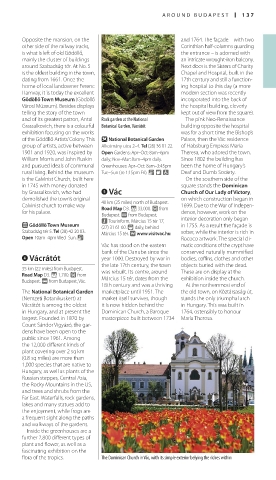
flora of the tropics. The Dominican Church in Vác, with its simple exterior belying the riches within
136-137_EW_Hungary.indd 137 18/09/17 3:40 pm

