


Page 146 - (DK Eyewitness) Travel Guide - Hungary
P. 146
144 HUNGAR Y AREA B Y AREA AROUND BUD APEST 145
E Margit Kovács Ceramics 7 Visegrád lived here most of his life until
Collection 40 km (25 miles) north of Budapest. his death in 1960. The museum
Kovács Margit Kerámiagyűjtemény Road Map C3. * 1,700. £ @ from displays personal artifacts,
Vastagh György utca 1. Tel (26) 92 Budapest. 4 from Budapest, family photos and some of his
09 90. Open 10am–6pm daily. & 7 Esztergom; from Szentendre (summer works, including A Bench in the
This 18th-century building only). ∑ visitvisegrad.hu Garden (1943).
(whose entrance is somewhat
hidden at the back of a court- Set on the narrowest stretch E István Szőnyi Memorial
yard) was originally a salt of the Danube, Visegrád is a Museum
storage facility, and became a popular village with visitors Bartóky utca 7. Tel (27) 62 01 61. Open
vicarage for the Blago vestenska dominated by its spectacular Mar–Oct: 9am–6pm Tue–Sun; Nov–Feb:
Church a century later. Since ruined Citadel. Built in the 13th 10am–4pm Tue–Sun. & 8
1973 it has been Szentendre’s century by King Béla IV, this was Hungarian and German. 7
best gallery, devoted to the once one of the finest royal ∑ szonyimuzeum.hu
eclectic work of Margit Kovács palaces in Hungary. The massive Zebegény’s Roman Catholic church, built in
(1902–77), a ceramic artist. outer walls are still intact, and Secessionist style 9 Nagybörzsöny
Kovács attended Budapest’s offer the visitor superb views. 8 Zebegény & Duna-Ipoly
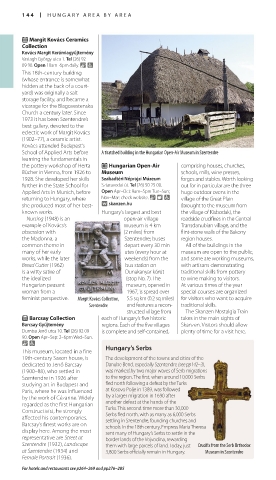
School of Applied Arts before A thatched building in the Hungarian Open-Air Museum in Szentendre Halfway down the hill, in the National Park
learning the fundamentals in Salamon Tower, is the Mátyás 30 km (19 miles) east of Vác. Road
the pottery workshop of Herta E Hungarian Open-Air comprising houses, churches, Museum, a collection of items Map C3. * 1,200. £ from Budapest. 24 km (15 miles) north of Visegrád.
Bücher in Vienna, from 1926 to Museum schools, mills, wine presses, excavated from the ruins of 4 from Budapest. Road Map C2/3. @ from Szob
1928. She developed her skills Szabadtéri Néprajzi Múzeum forges and stables. Worth looking the Royal Palace. Built by King (to Nagybörzsöny). ∑s dinpi.hu
further in the State School for Sztaravodai út. Tel (26) 50 25 00. out for in particular are the three Sigismund in the 14th century, Famous for fine views of the
Applied Arts in Munich, before Open Apr–Oct: 9am–5pm Tue–Sun; huge outdoor ovens in the it was renovated a century later, Danube Bend, the tiny village of Home to the fine 14th-century
returning to Hungary, where Nov–Mar: check website. & 8 7 village of the Great Plain in magnificent Renais sance style, Zebegény also boasts one stone Romanesque Church of
she produced most of her best- ∑ skanzen.hu (brought to the museum from by Mátyás Corvinus (see p41). It of Hun gary’s few Catholic St Stephen, a working mid-
known works. Hungary’s largest and best the village of Kisbodak), the fell derelict in the 16th century churches in Seces sion 19th-century water mill
Nursing (1948) is an open-air village roadside crucifixes in the Central after the Turkish invasion and style. Designed by (open to the public) and
example of Kovács’s museum is 4 km Transdanubian village, and the was then buried in a mudslide. Károly Kós, Dénes a mining museum,
obsession with (2 miles) from flint-stone walls of the Bakony The ruins were not rediscovered Györgyi and Béla Nagybörzsöny is best
the Madonna, a Szentendre; buses region houses. until 1934, when excavations Jánszky and built from known as the gateway
common theme in depart every 30 min- All of the buildings in the took place. Now largely recon- 1910 to 1914, its plain to the Duna-Ipoly
many of her early utes (every hour at museum are open to the public, structed and whitewashed, façade has Neo- National Park, one
works, while the later weekends) from the and some are working museums, several rooms recreate life in Romanesque traits. It of the largest in
Bread Cutter (1962) bus station on with artisans demonstrating the Renais sance Palace. is its sharply angled the country. The
is a witty satire of Dunakanyar körút traditional skills from pottery and tiered, Christmas- Buda Hill caves
the idealized (stop No. 7). The to wine making to visitors. + Citadel tree-like roof that sets the and the Sas-hegy
Hun garian peasant museum, opened in At various times of the year Tel (26) 39 81 01. Open Mar–Oct: church apart, while the tall nature trail outside
woman from a 1967, is spread over special courses are organized 9am–5pm daily; May–Sep: 9am–6pm adjoining spire adds Budapest are also
feminist perspective. Margit Kovács Collection, 5.5 sq km (0.2 sq miles) for visitors who want to acquire daily; Oct–Nov: 9am–4pm daily; Dec– elegance. Inside, the Signpost in Duna-Ipoly within its borders.
Szentendre and features a recon- traditional skills. Feb: 10am–4pm Fri–Sun. colourful frescoes of St National Park The park is home
structed village from The Skanzen Nostalgia Train E Mátyás Museum Constantine are the last to more than 70
E Barcsay Collection each of Hungary’s five historic takes in the main sights of Salamon-torony utca. Tel (26) 59 major works by the master protected plants and more than
Barcsay Gyűjtemény regions. Each of the five villages Skanzen. Visitors should allow 70 10. Open May–Oct: 9am–5pm painter Kriesch Aladár Körösfői half of Hungary’s native bird
Dumtsa Jenő utca 10. Tel (26) 92 09 is complete and self-contained, plenty of time for a visit here. Wed–Sun. & (1863–1920). species (including black and
90. Open Apr–Sep: 2–6pm Wed–Sun. P Royal Palace Behind the church is the István white-backed woodpeckers).
& 7 Fő utca 23. Tel (26) 59 70 10. Szőnyi Memorial Museum. One A narrow-gauge railway
This museum, located in a fine Hungary’s Serbs Open Mar–Oct: 9am–5pm; Nov–Feb: of the most prominent Hungarian runs at week ends from
19th-century Saxon house, is The development of the towns and cities of the 10am–4pm. & 8 Expres sionist painters, Szőnyi Nagybörzsöny to Nagyirtás
dedicated to Jenő Barcsay Danube Bend, especially Szentendre (see pp142–3), across the Börzsöny Hills, from
(1900–88), who settled in was marked by two major waves of Serb migrations where well-marked hiking trails
Szen tendre in 1926 after to the region. The first, when around 10,000 Serbs fan out across the park. There is
studying art in Budapest and fled north following a defeat by the Turks also a long trail from Nagy bör-
Paris, where he was influenced at Kosovo Polje in 1389, was followed zsöny itself, leading up to Nagy
by the work of Cézanne. Widely by a larger migration in 1690 after Hideg Hegy peak, which offers
regarded as the first Hungarian another defeat at the hands of the views across to Slovakia.
Turks. This second time more than 30,000
Construc tivist, he strongly Serbs fled north, with as many as 6,000 Serbs A second narrow-gauge
affected his contemporaries. settling in Szentendre, founding churches and railway, from Kismaros to
Barcsay’s finest works are on schools. In the 18th century, Empress Maria Theresa Királyrét, opens up the
display here. Among the most sent many of Hungary’s Serbs to settle in the southern part of the park.
representative are Street at border lands of the Vojvodina, rewarding There are hiking trails from
Szentendre (1932), Landscape them with large parcels of land. Today, just Crucifix from the Serb Orthodox Királyrét across the hills, and
at Szentendre (1934) and 3,800 Serbs officially remain in Hungary. Museum in Szentendre on to Nógrád, where there
Female Portrait (1936). The spectacular ruins of the citadel, towering over Visegrád is a spectacular ruined castle.
For hotels and restaurants see p264–269 and pp276–285
144-145_EW_Hungary.indd 144 18/09/17 3:40 pm 144-145_EW_Hungary.indd 145 18/09/17 3:40 pm

