


Page 148 - (DK Eyewitness) Travel Guide - Hungary
P. 148
146 HUNGAR Y REGION B Y REGION ESZTERGOM 147
0 Esztergom rounded façade and high nave. processions. It is thought not VISITORS’ CHECKLIST
The twin spires were added much to contain any human remains:
St István, Hungary’s first king, was baptized in Eszter gom, later, in the middle of the 19th its purpose has always been Practical Information
and crowned here on Christmas Day in the year 1000. Almost century. The Baroque interior was symbolic. The room devoted to Road Map C3. * 28,357.
_ Castle Theatre (Jul–Aug);
completely destroyed by the Mongol invasion 250 years unfortunately lost during World altar pieces, some dating back History Days Festival (late
later, the town was gradually rebuilt during the 18th and War II, and has yet to be replaced. to the 14th century, is stunning Aug–early Sep).
19th centuries. Esztergom today is still Hungary’s most sacred The statue in front of the church in its colour and historical import. Transport
city, the seat of the Archbishop of Hungary. Although it is was raised in 1740 by the Tamás Koloszvári’s Ascension is £ Bem József tér. @ Simor
considered the most significant
people of Esztergom, grateful
János utca. 4 Nagy-Duna sétány
dominated by the huge Basilica (see pp148–9), Esztergom has for having survived an outbreak medieval painting in Hungary. (summer only).
much to offer besides its mighty cathedral, including one of of the plague. A bridge behind Besides the picture gallery,
Hungary’s oldest castles, the picturesque and eclectic district the church leads to Prímás there are equally stunning
of Víziváros (Watertown), the fascinating Danube Museum Sziget, an island of gardens sculpture and icon galleries. previous home on the Danube.
and Hungary’s finest collection of ecclesiastical art. and parks in the Danube, The museum houses all sorts
from where another bridge E Bálint Balassa Museum The Danube Museum, devoted to life of hydraulic equipment from
crosses the river into Slovakia. MNM Balassa Bálint Múzeum with the river the past century, as well as
R Esztergom Basilica can be visited, but the study of Mindszenty tér 5. Tel (33) 50 01 75. exhibits devoted to damming
See pp148–9. Matyas’s tutor is currently closed Open Mar–Oct: 10am–6pm Tue–Sun; E Danube Museum and the Danube and navigation,
due to construction work, with Nov–Feb: 10am–4pm Tue–Sun. Lower Esztergom water supply and purification.
+ Royal Palace and Castle no date set for re-opening. & 8 Duna Múzeum & Belváros There is a collection of
Museum To the south and north are Situated opposite the Vízi város Kölcsey utca 2. Tel (33) 50 02 50. engineering tools, as well as a
Vár & Vármúzeum well- preserved remains of the Parish Church, the Bálint Balassa Open Feb, Nov & Dec: 10am–4pm history of water management
Szent István tér 1. Tel (33) 41 59 86. ram parts and steps back into Museum is named after a Wed–Mon; Mar–Oct: 9am–5pm since Roman times. Children
Open Apr–Oct: 10am–6pm Tue–Sun; the town. The Esztergom Castle Renaissance poet who died in Wed–Mon. Closed Tue and Jan. will enjoy the many hands-on
Nov–Mar: 10am–4pm Tue–Sun. _ Theatre stages plays in summer, 1594 while fighting the Turks. 8 7 displays, which enable them
& 8 and the castle also hosts the The over 120-year-old museum The role of the Danube in the to get very wet indeed.
Opposite Esztergom Basilica are History Days festival in September. underwent a major refurbish- history and development of A 5-minute walk south
the partly reconstructed remains ment in 2014 and exhibits Esztergom is given due impor- along Vörösmary utca leads
of the Royal Palace, one of the P Víziváros now showcase archaeological tance in this outstanding to Széchenyi tér, centre of the
oldest buildings in Hungary. Berényi utca artifacts, weapons from the museum close to the city Lower Town and surrounded
The southern walls date back Víziváros (Watertown) is a 18th to the 20th centuries, ship centre. The building itself is a on all sides by a mixture of
to the 10th century. From 1256 district of mainly Baroque models, antique furniture and gem. It was built in the 18th Baroque and Neo-Classical
onwards it was the palace of buildings, narrow streets, a rich book collection. Also century in Baroque style and houses, many of which are now
Esztergom’s archbishops, single-storey houses and displayed are 18th-century was a crumbling wreck until cafés. Its focal point is the town
and improve ment was tiny well-kept gardens. The tableware and other interesting renovated in 1973, when the hall, an immaculately preserved
continuous right up area was developed ethnographic items. museum moved here from its Rococo building from 1729.
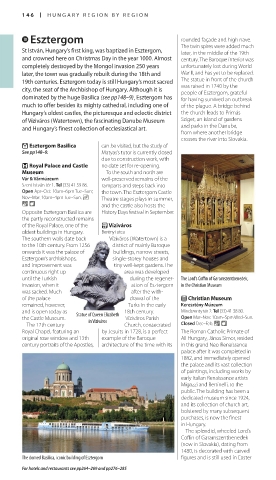
until the Turkish during the regener- The Lord’s Coffin of Garamszent benedek,
invasion, when it ation of Esztergom in the Christian Museum
was sacked. Much after the with- Esztergom City Centre
of the palace drawal of the E Christian Museum 1 Basilica pp148–9 SZENTGYÖRGYMEZŐ
remained, however, Turks in the early Keresztény Múzeum 2 Royal Palace and Castle St. Adalbert
and is open today as Statue of Queen Elizabeth 18th century. Mindszenty tér 2. Tel (33) 41 38 80. Museum Center ISKOLA UTCA
the Castle Museum. in Viziváros Víziváros Parish Open Mar–Nov: 10am–5pm Wed–Sun. 3 Víziváros SZENT
ISTVÁN
The 12th century Church, consecrated Closed Dec–Feb. & 8 4 Christian Museum Basilica Dark TÉR
Gate
Royal Chapel, featuring an by Jesuits in 1728, is a perfect The Roman Catholic Primate of 5 Bálint Balassa Museum BÁNOM
original rose window and 13th exam ple of the Baroque All Hungary, János Simor, resided 6 Danube Museum and B ER É N Y I UTCA
century portraits of the Apostles, architecture of the time with its in this grand Neo-Renaissance Danube Royal Palace
and Castle Museum
palace after it was completed in Lower Esztergom Rondella BA SA UTCA
1882, and immediately opened VÍZIVÁROS MAJER ISTVÁN
the palace and its vast collection UTCA
of paintings, including works by Christian Bálint Balassa B AT T HYÁ NY U TCA SZENT VA SVÁR I PAL UT CA
Museum
early Italian Renaissance artists Víziváros Museum TAMÁS-HEGY
TERE
Parish
Migazzi and Bertinelli, to the Church MÍNDSZENTY PÁ Z MÁ NY UTCA Chapel
public. The building has been a
dedicated museum since 1924, Kossuth TÖ R Ö K UT C A
híd
and its collection of church art, Kis-Duna ATTÍLA BAJCSY-ZSILINSZKY UTCA
TÉR
bolstered by many subsequent
purchases, is now the finest Mária Outdoor
in Hungary. Valéria NAGY DUNA SÉTÁNY Pool IMAHÁZ UTCA
híd
The splendid, wheeled Lord’s Customs KIS-DUNA SÉTÁNY and Lower Estergom
Danube Museum
Coffin of Garamszentbenedek House TÁ NC SIC S MIH ALY U T C A
UTCA
(now in Slovakia), dating from 0 metres 200 Bottyan VÖRÖSMARTY
1480, is decorated with carved 0 yards 200 híd LŐ R I NC Z U TCA Train Station
1.2 km (0.7 miles)
The domed Basilica, iconic building of Esztergom figures and is still used in Easter RÁKÓCZI Bus Station
TÉR 1 km (0.6 miles)
For hotels and restaurants see pp264–269 and pp276–285 For keys to map symbols see back flap
146-147_EW_Hungary.indd 146 18/09/17 3:40 pm 146-147_EW_Hungary.indd 147 18/09/17 3:40 pm

