


Page 164 - (DK Eyewitness) Travel Guide - Hungary
P. 164
162 HUNGAR Y REGION B Y REGION NOR THERN TR ANSD ANUBIA 163
8 Sümeg Zalaegerszeg’s city centre is (Őrségi Népi Műem léke gyüttes).
43 km (27 miles) north of Keszthely. brightened up by the former Here, visitors can see an Őrség
Road Map B4. * 7,000. £ from synagogue, today a concert house as it would have looked
Keszthely, Tapolca. @ from Keszthely, and exhibition hall. Designed in the early 19th century,
Zalaegerszeg. n Tourinform, Kossuth by József Stern, its bright and complete with cooking utensils
Lajos utca 15, (20) 417 63 46. lively motifs betray its late and other domestic items.
Secession-era construction Other settlements worth visiting
This pretty town has been (1904), though the two domes are Velemér, which has a
inhabited since Roman times add a little religious dignity. 14thcentury church with fine
and is dominated by its castle, frescoes, and Hegyhátszent
which sits atop the 270-m- E Göcseji Village Museum & jakab, where visitors can admire
(885-ft-) high Castle Hill. Sümeg Finno-Ugric Ethnographical a splendid medieval church.
Castle (Sümeg Vár), first built in Museum Nearby, Lake Vadása is
the 13th century though almost Falumúzeum utca. Tel (92) 70 32 95. popular with swimmers and
completely reconstructed in Open Apr–Oct: 10am–6pm Tue–Sun; anglers. On the northern
the 16th, is one of the best Nov–Mar: 10am–4pm Tue–Sat. & 8 borders of the Őrség are two
preserved in Hungary. It houses Hungarian. 7 ∑ gocsejiskanzen.hu towns of note: Szentgotthárd
an exhibition on the town’s Decorative elements on the former and Körmend. Both are good
history, weapons, and coaches, synagogue in Zalaegerszeg Őriszentpéter, the largest of the villages in the Őrség region access points for the Őrség, and
as well as a hair-raisingly realistic both have attractions of their
torture chamber. During the 9 Zalaegerszeg q Őrség Region is rightly proud of its own: Körmend is home to the
summer there are lively re- 44 km (27 miles) east of Keszthely. 50 km (31 miles) west of Zala eger szeg. 13thcentury Romanesque Baroque Batthány Mansion
enactments of historic battles, Road Map A4. * 60,000. £ from Road Map A4. £ to Szent gotthárd St Peter Church, at Templomszer built for the family in the
jousting contests and medieval Budapest. @ from Keszthely. from Körmend. @ to Őriszentpéter 15. It is almost entirely original, 17th century. A small part of
dancing in the courtyard. n Tourinform, Széchenyi tér 4–6, Őrség from Szentgotthárd and containing fragments of the building is open to visitors.
Tourinform will have details (92) 31 61 60. ( Piac tér, daily. Körmend. n Tourinform Őrség, Siska 16thcentury frescoes, which, At Szentgotthárd the ceiling
of performances. ∑ zalaegerszegturizmus.hu szer 26A, Őriszentpéter, (94) 54 80 34. given the number of fires frescoes of the Cistercian
The town’s main attraction, that have plagued the village Monastery Church, painted
however, is the Roman Cath olic Zalaegerszeg, capital of the Since the 10th century and the over time, is little short in 1785 by István Dorfmeister,
Church of the Ascension Zala region and Hun gary’s first Magyar excursions into of miraculous. are outstanding.
(built 1756–7) on Bíró Márton leading oil town, has a number the region, the Őrség has been Six km (4 miles) away, Szalafő
utca. Though unspectacular of attractions that make a stop a frontier land, populated by is the secondlargest village in E Szalafő OpenAir
from outside, inside it has a here worthwhile. The first is Statue of Sándor Petőfi and a soldier, hardy warriors who swore to the region, consisting of six Ethnographical Museum
series of frescoes by Austrian the Göcseji Village Museum in Nagykanizsa defend Hungary’s borders in szers. The largest of these is Pityerszer 12. Tel (94) 54 80 34. Open
Franz Anton Maulbertsch, a (Göcseji Falumúzeum), the exchange for a lifetime’s tax today the Szalafő OpenAir Apr–Oct: 10am–5pm daily (to 6pm
leading figure in late Baroque oldest such in Hungary, 0 Nagykanizsa exemption. Covered in lush Ethno graphical Museum Jun–Aug). & 8 Hungarian only. 7
art. The frescoes, perhaps his located on a tran quil back 50 km (23 miles) south of Zala eger- forests, the gently sloping
greatest work, were painted in water of the River Zala. Set szeg. Road Map A5. * 53,000. £ hills of the Őrség – today
1757–8 and tell the story of the up in 1968, it displays more from Budapest. @ from Keszthely, designated a National Park –
gospel, from the Annun ciation than 40 buildings, brought Zalaegerszeg. n Tour inform, were traditionally sprinkled
below the organ gallery to the here from 22 nearby villages. Csengery utca 1–3, (93) 31 32 85. with small hilltop settlements,
Ascension in the dome. The famous Nodding Jennies never comprising more than
are part of the Museum of the Originally a castle town, 10 houses. Some 18 of these
+ Sümeg Castle Hungarian Petroleum Industry, Nagykanizsa found wealth in settlements remain, almost all of
Tel (87) 35 27 37 or (30) 625 70 03. the second significant oil and the late 17th century first as a which are beautifully preserved,
Open daily, subject to weather. & gas museum in Europe. cattle-trading town, then in the many containing wooden
late 19th century as a hub for houses with characteristic
food processing. The city centre overhanging roofs, dating
around Szabadság tér was built back to the 13th century. The
over the site of the castle, used settlements, called szers, all
as a mosque by the Turks and follow the same pattern: the
destroyed by the Habsburgs in houses are grouped around
1705. The fountain in the middle a courtyard, in the middle of
of the square marks the former which are stables.
castle entrance. The Baroque The largest of the Őrség
Catholic church, on Zárda utca, villages is Őriszentpéter, which
was built in 1702–14 using in June hosts the Őrség Fair,
remnants of the castle. The a weekend of folk music, craft
city’s Neo-Classical synagogue, fairs and traditional dancing
at Fő utca 6, built in 1807–10, competitions. Őriszentpéter
is being restored. In the is, in fact, a collection of
middle of Déak tér is a statue timber and thatched szers
of the Hungarian poet Sándor that came together to form
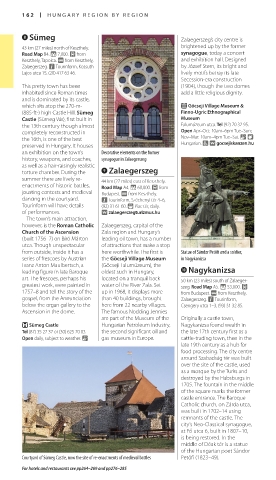
Courtyard of Sümeg Castle, now the site of re-enactments of medieval battles Petőfi (1823–49). one community. The village The grand façade of the 17th-century Batthány Mansion in Körmend
For hotels and restaurants see pp264–269 and pp276–285 The library at Pannonhalma Abbey, a magnificent repository of Hungarian scholarship
162-163_EW_Hungary.indd 162 18/09/17 3:40 pm 162-163_EW_Hungary.indd 163 18/09/17 3:40 pm

