


Page 165 - (DK Eyewitness) Travel Guide - Hungary
P. 165
NOR THERN TR ANSD ANUBIA 163
(Őrségi Népi Műem léke gyüttes).
Here, visitors can see an Őrség
house as it would have looked
in the early 19th century,
complete with cooking utensils
and other domestic items.
Other settlements worth visiting
are Velemér, which has a
14thcentury church with fine
frescoes, and Hegyhátszent
jakab, where visitors can admire
a splendid medieval church.
Nearby, Lake Vadása is
popular with swimmers and
anglers. On the northern
borders of the Őrség are two
towns of note: Szentgotthárd
and Körmend. Both are good
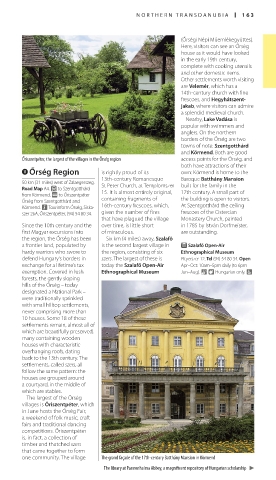
Őriszentpéter, the largest of the villages in the Őrség region access points for the Őrség, and
both have attractions of their
q Őrség Region is rightly proud of its own: Körmend is home to the
13thcentury Romanesque Baroque Batthány Mansion
50 km (31 miles) west of Zala eger szeg. St Peter Church, at Templomszer built for the family in the
Road Map A4. £ to Szent gotthárd
from Körmend. @ to Őriszentpéter 15. It is almost entirely original, 17th century. A small part of
Őrség from Szentgotthárd and containing fragments of the building is open to visitors.
Körmend. n Tourinform Őrség, Siska 16thcentury frescoes, which, At Szentgotthárd the ceiling
szer 26A, Őriszentpéter, (94) 54 80 34. given the number of fires frescoes of the Cistercian
that have plagued the village Monastery Church, painted
Since the 10th century and the over time, is little short in 1785 by István Dorfmeister,
first Magyar excursions into of miraculous. are outstanding.
the region, the Őrség has been Six km (4 miles) away, Szalafő
a frontier land, populated by is the secondlargest village in E Szalafő OpenAir
hardy warriors who swore to the region, consisting of six Ethnographical Museum
defend Hungary’s borders in szers. The largest of these is Pityerszer 12. Tel (94) 54 80 34. Open
exchange for a lifetime’s tax today the Szalafő OpenAir Apr–Oct: 10am–5pm daily (to 6pm
exemption. Covered in lush Ethno graphical Museum Jun–Aug). & 8 Hungarian only. 7
forests, the gently sloping
hills of the Őrség – today
designated a National Park –
were traditionally sprinkled
with small hilltop settlements,
never comprising more than
10 houses. Some 18 of these
settlements remain, almost all of
which are beautifully preserved,
many containing wooden
houses with characteristic
overhanging roofs, dating
back to the 13th century. The
settlements, called szers, all
follow the same pattern: the
houses are grouped around
a courtyard, in the middle of
which are stables.
The largest of the Őrség
villages is Őriszentpéter, which
in June hosts the Őrség Fair,
a weekend of folk music, craft
fairs and traditional dancing
competitions. Őriszentpéter
is, in fact, a collection of
timber and thatched szers
that came together to form
one community. The village The grand façade of the 17th-century Batthány Mansion in Körmend
The library at Pannonhalma Abbey, a magnificent repository of Hungarian scholarship
162-163_EW_Hungary.indd 163 18/09/17 3:40 pm

