


Page 182 - (DK Eyewitness) Travel Guide - Hungary
P. 182
180 HUNGAR Y REGION B Y REGION NOR THERN TR ANSD ANUBIA 181
h Pannonhalma Abbey Cloister
Late Gothic vaulting in the VISITORS’ CHECKLIST
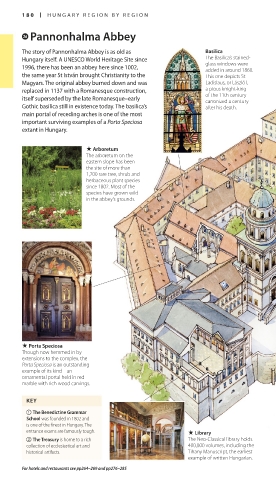
The story of Pannonhalma Abbey is as old as Basilica cloister was added during Practical Information
renovation of the abbey,
Hungary itself. A UNESCO World Heritage Site since The Basilica’s stained- carried out during the reign Vár 1, Pannonhalma, 20 km (12
glass windows were
1996, there has been an abbey here since 1002, added in around 1860. of King Mátyás, in 1486. miles) SE of Győr. Road Map B3.
Tel (96) 57 01 91. Open 21 Mar–
the same year St István brought Christianity to the This one depicts St Apr & Oct–11 Nov: 9am–4pm
Magyars. The original abbey burned down and was Ladislaus, or László I, Tue–Sun; May: 9am–4pm daily;
replaced in 1137 with a Romanesque construction, a pious knight-king Jun–Sep: 9am–5pm daily; 12
of the 11th century
itself superseded by the late Romanesque–early canonized a century Nov–20 Mar: 10am–3pm Tue–
Sun. Library: Tel (96) 57 01 91.
Gothic basilica still in existence today. The basilica’s after his death. & 8 7 ^ Abbey. 0 =
main portal of receding arches is one of the most Transport
important surviving examples of a Porta Speciosa £ @
extant in Hungary.
. Arboretum
The arboretum on the
eastern slope has been
the site of more than
1,200 rare tree, shrub and
herbaceous plant species
since 1802. Most of the
species have grown wild
in the abbey’s grounds.
Our Lady Chapel
On the far side of the abbey, Our Lady
Chapel has three Baroque altars and a tiny
organ. The abbey’s monks are buried here.
Western Tower
Very much the abbey’s calling card,
and its most recognizable feature,
the Western Tower, added in 1832,
. Porta Speciosa can be seen from far away.
Though now hemmed in by Main entrance
extensions to the com plex, the
Porta Speciosa is an outstanding
example of its kind – an
ornamental portal held in red
marble with rich wood carvings. The Benedictine Order
The Order of St Benedict, oldest of the religious orders, was founded by
KEY Benedict of Nursia, who set up the first monastery at Monte Cassino, Italy,
in 529. Benedict wanted to re-establish a sense of community in the
1 The Benedictine Grammar turmoil after the collapse of the Roman Empire, and ever since commu-
School was founded in 1802 and nity and hospitality have been the hallmarks of the Benedictines.
is one of the finest in Hungary. The Benedictine monks are known for living by their labour; Pannonhalma
entrance exams are famously tough. . Library is no exception. The 40 monks who still live at the abbey oversee
the production and sales of the wine (vineyards surround the
2 The Treasury is home to a rich The Neo-Classical library holds abbey), Benedic tine liqueur, honey, tea and lavender products.
collection of ecclesiastical art and 400,000 volu mes, including the
historical artifacts. Tihany Manu script, the earliest A wine produced at Pannonhalma
example of written Hungarian.
For hotels and restaurants see pp264–269 and pp276–285
180-181_EW_Hungary.indd 180 18/09/17 3:40 pm 180-181_EW_Hungary.indd 181 18/09/17 3:40 pm

