


Page 178 - (DK Eyewitness) Travel Guide - Hungary
P. 178
176 HUNGAR Y REGION B Y REGION NOR THERN TR ANSD ANUBIA 177
f Moson- k Tata
magyaróvár 60 km (37 miles) east of Győr.
37 km (23 miles) northwest of Győr. Road Map C3. * 24,000. £ from
Road Map B3. * 32,000. £ from Budapest. @ from Budapest.
n Tourinform, Ady Endre utca 9,
Győr. @ from Győr. n Tourinform,
Kápolna tér 16, (96) 20 63 04. _ (34) 58 60 45.
Voluta International Water Festival
(Jun); Summer Festival (Aug). Sitting on the banks of Lake
Öreg, Tata is often referred
The Romans built a fortress at to as the Hungarian Venice,
Magyaróvár in the 3rd century AD. mainly for the moated castle
It was later extended by the Huns on the lake’s north bank. Little
and then the Magyars, who con- except one tower and a wall
structed a large mud-brick fortress remain of the 15th-century
here. In 1271 Ottocar of Bohemia original: most of the current,
replaced this structure with the never theless impressive,
present stone Magyaróvár build ing dates from 1893.
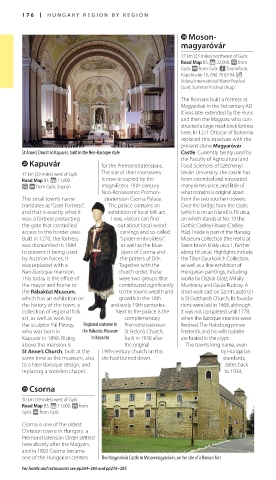
St Anne’s Church in Kapuvár, built in the Neo-Baroque style Castle. Currently being used by Aerial view of the largely hidden Monostor Fortress in Komárom The lake was once sur rounded
the Faculty of Agricultural and by water mills, but only a few
s Kapuvár for the Premon strat ens ians. Food Sciences of Széchenyi when the two separate towns of largest fortress in the country, remain; the Cifra Mill next to
47 km (29 miles) west of Győr. The site of their monastery István University, the castle has Moson and Magyaróvár became and one of the largest in Europe. the castle is the oldest, dating
Road Map B3. * 11,000. is now occupied by the been extended and renovated one and the two names simply Most of it is invisible from outside, from 1587. Another mill a
£ @ from Győr, Sopron. magnificent 19th-century many times since, and little of joined together. as it is buried underground. It short distance north houses
Neo-Renaissance Premon- what remains is original apart was sparsely used by the Habs- the German Minorities Museum,
This small town’s name stratensian Csorna Palace. from the two southern towers. + Magyaróvár Castle burgs before becoming the with interesting artifacts from
translates as “Gate For tress”, The palace contains an Over the bridge from the castle Vár utca 2. Tel (96) 56 66 37. property of the Hungarian army, the region’s once numerous
and that is exactly what it exhibition of local folk art. (which is on an island) is Fő utca, Open 7:30am–6pm Mon–Fri. who used it as a training camp. German population.
was: a fortress protecting Here, visitors can find on which stands at No. 19 the & 7 to the grounds. After World War II, the Soviet On the other side of the
the gate that controlled out about local wood Gothic Cselley House (Cselley army held political prisoners castle, on central Hősök tér,
access to the border area. carvings and so-called Ház). Inside is part of the Hanság g Győr here. The story of the fortress is is the eclectic Ester házy
Built in 1270, the fortress “spider embroidery”, Museum collection (the rest is at told clearly in the museum that Mansion, built in 1777. Used
was dismantled in 1884 as well as the blue- Szent István Király utca 1, further See pp178–9. now occupies much of the main as a mental hospital for years,
to prevent it being used dyers of Csorna and along Fő utca). High lights include bastion. There is also a bread it has now been largely restored.
by Austrian forces. It the potters of Dör. the Tibor Gyurkovich Col lection, museum, where visitors may Across the square is the
was replaced with a Together with the as well as a fine exhibition of h Pannonhalma taste the “ration bread” given Greco-Roman Statue Museum,
Neo-Baroque mansion. church order, these Hungarian paint ings, including Abbey to the soldiers who had to man a former synagogue containing
This today is the office of were two groups that works by Oszkár Glatz, Mihály the place in the 19th century. The full-size replicas of classical
the mayor and home to contributed significantly Munkácsy and Gyula Rudnay. A See pp180–81. fortress hosts cultural events and statuary, from David to Zeus.
the Rábaközi Museum, to the town’s wealth and short walk east on Szent Laszló tér battle recreations throughout On the shore of Tata’s second
which has an exhibition on growth in the 18th is St Gotthard’s Church. Its founda- j Komárom the summer. lake, Lake Cseske, stands the
the history of the town, a and early 19th centuries. tions were laid in 1668, although folly of a ruined church.
collection of regional folk Next to the palace is the it was not comp leted until 1778, 38 km (24 miles) northeast of Győr. + Monostor Fortress
art, as well as work by complementary when the Baroque interiors were Road Map C3. * 20,000. Monostori Erőd, Dunapart 1. Tel (34) 54 E Greco-Roman Statue Museum
the sculptor Pál Pátzay, Regional costume in Premon stra tensian finished. The Habsburg prince £ from Budapest, Győr. @ from 05 82. Open 9am–6pm daily. & 8 Hősök tere 7. Tel (34) 38 12 51. Open
who was born in the Rábaköz Museum St Helen’s Church, Frederick and his wife Isabelle Győr. n Tourinform, Igmándi út 2, Tue–Sun; book tours in English a week Apr–Oct 10am–6pm Tue–Sun; Nov–
Kapuvár in 1896. Rising in Kapuvár built in 1938 after are buried in the crypt. (34) 54 05 90. in advance. ∑ fort-monostor.hu Mar by appointment only. & 7
above the mansion is the original The town’s long name, even
St Anne’s Church, built at the 19th-century church on this by Hun garian A real border town, split in two by
same time as the museum, also site had burned down. standards, nature (the Danube) and politics (it
to a Neo-Baroque design, and dates back straddles the Hungarian-Slovakian
replacing a wooden chapel. to 1939, border), Komárom is the main
crossing point between the two
d Csorna countries. Until 1920 this was one
town, and on both sides of the
30 km (19 miles) west of Győr. river the two languages appear
Road Map B3. * 11,000. £ from to be spoken inter-changeably.
Győr. @ from Győr. The Hungarian part of the
town is known for the colossal
Csorna is one of the oldest Monostor Fortress (Monostori
Christian towns in Hungary: a Erőd), built by the Habs burgs
Premonstratensian Order settled 2 km (1 mile) upriver from the
here shortly after the Magyars, city centre after the 1848–9
and in 1802 Csorna became uprising. Covering approximately
one of the Hungarian centres The Magyaróvár Castle in Mosonmagyaróvár, on the site of a Roman fort 4 hectares (10 acres), it is the Replicas of famous statues in the Greco-Roman Statue Museum in Tata
For hotels and restaurants see pp264–269 and pp276–285
176-177_EW_Hungary.indd 176 18/09/17 3:40 pm 176-177_EW_Hungary.indd 177 18/09/17 3:40 pm

