


Page 179 - (DK Eyewitness) Travel Guide - Hungary
P. 179
NOR THERN TR ANSD ANUBIA 177
k Tata
60 km (37 miles) east of Győr.
Road Map C3. * 24,000. £ from
Budapest. @ from Budapest.
n Tourinform, Ady Endre utca 9,
(34) 58 60 45.
Sitting on the banks of Lake
Öreg, Tata is often referred
to as the Hungarian Venice,
mainly for the moated castle
on the lake’s north bank. Little
except one tower and a wall
remain of the 15th-century
original: most of the current,
never theless impressive,
build ing dates from 1893.
Aerial view of the largely hidden Monostor Fortress in Komárom The lake was once sur rounded
by water mills, but only a few
when the two separate towns of largest fortress in the country, remain; the Cifra Mill next to
Moson and Magyaróvár became and one of the largest in Europe. the castle is the oldest, dating
one and the two names simply Most of it is invisible from outside, from 1587. Another mill a
joined together. as it is buried underground. It short distance north houses
was sparsely used by the Habs- the German Minorities Museum,
+ Magyaróvár Castle burgs before becoming the with interesting artifacts from
Vár utca 2. Tel (96) 56 66 37. property of the Hungarian army, the region’s once numerous
Open 7:30am–6pm Mon–Fri. who used it as a training camp. German population.
& 7 to the grounds. After World War II, the Soviet On the other side of the
army held political prisoners castle, on central Hősök tér,
here. The story of the fortress is is the eclectic Ester házy
g Győr told clearly in the museum that Mansion, built in 1777. Used
See pp178–9. now occupies much of the main as a mental hospital for years,
bastion. There is also a bread it has now been largely restored.
museum, where visitors may Across the square is the
h Pannonhalma taste the “ration bread” given Greco-Roman Statue Museum,
Abbey to the soldiers who had to man a former synagogue containing
the place in the 19th century. The
full-size replicas of classical
See pp180–81. fortress hosts cultural events and statuary, from David to Zeus.
battle recreations throughout On the shore of Tata’s second
j Komárom the summer. lake, Lake Cseske, stands the
folly of a ruined church.
38 km (24 miles) northeast of Győr. + Monostor Fortress
Road Map C3. * 20,000. Monostori Erőd, Dunapart 1. Tel (34) 54 E Greco-Roman Statue Museum
£ from Budapest, Győr. @ from 05 82. Open 9am–6pm daily. & 8 Hősök tere 7. Tel (34) 38 12 51. Open
Győr. n Tourinform, Igmándi út 2, Tue–Sun; book tours in English a week Apr–Oct 10am–6pm Tue–Sun; Nov–
(34) 54 05 90. in advance. ∑ fort-monostor.hu Mar by appointment only. & 7
A real border town, split in two by
nature (the Danube) and politics (it
straddles the Hungarian-Slovakian
border), Komárom is the main
crossing point between the two
countries. Until 1920 this was one
town, and on both sides of the
river the two languages appear
to be spoken inter-changeably.
The Hungarian part of the
town is known for the colossal
Monostor Fortress (Monostori
Erőd), built by the Habs burgs
2 km (1 mile) upriver from the
city centre after the 1848–9
uprising. Covering approximately
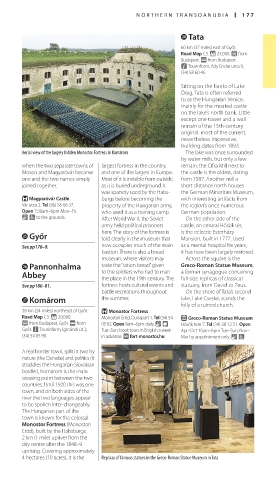
4 hectares (10 acres), it is the Replicas of famous statues in the Greco-Roman Statue Museum in Tata
176-177_EW_Hungary.indd 177 18/09/17 3:40 pm

