


Page 180 - (DK Eyewitness) Travel Guide - Hungary
P. 180
178 HUNGAR Y REGION B Y REGION NOR THERN TR ANSD ANUBIA 179
g Győr in 1257–67. The 15th-century by Margit Kovács built by the Jesuits VISITORS’ CHECKLIST
Gothic Chapel houses the Holy (1902–77), a local-born in 1627. The beautiful
Located exactly halfway between Budapest and Vienna, Herm, the remains of St László, ceramic artist who Baroque pulpit was Practical Information
where the rivers Danube, Rába and Rábca meet, Győr has one of Hungary’s most sacred is Hungary’s leading added in 1757. After 120 km (74 miles) west of
long been the place where empires met, and often clashed. relics. A fire destroyed the towers 20th-century abstract the Jesuit order was Budapest. Road Map B3.
* 125,000. n Tourinform,
dissolved in 1802, the
Celts founded the city, and called it Arrabona, before giving around 1580, and the cathedral sculptor. Items on Bene dictines added Baross Gábor utca 21, (96) 33 68
was remodelled by the Italian
display range from
way to the Romans. The Magyars saw the value of the town’s architect Giovanni Rava in the vases to religious the two towers. Next 17. ( daily flower market, Arany
position and created a bishopric here, while during the 17th century. The Baroque pieces, with personal to the church stands János utca. _ Four Seasons
Turkish wars it became the home of the most impenetrable interior dates from the time items and a model Ceramics on the stairs a working Phar macy Festival (summer).
fortress in Hungary at the time. Full of monuments and after the Turkish period, of her workshop. at the Margit Kovács Museum boasting Transport
£ Révai Miklós utca; from
buildings that tell of its eventful past, Győr is also a modern, when the altarpieces and P Széchenyi Square Exhibition the beautifully carved Budapest.
superb frescoes by Franz Anton
ceiling. The Maria
vibrant city. Outstanding communications make it an Maulbertsch were added. Széchenyi tér 4. Imre Patkó Collec tion: Column outside was built
excellent base for exploring the Győr–Moson–Sopron region. The painting of the Virgin Mary Tel (96) 31 05 88. Open 10am–6pm in 1686 to celebrate Buda’s
above the Baroque altar is one Tue-Sun. Esterhazy Palace: Tel (96) 32 recapture from the Turks.
+ Bishop’s Palace of Hungary’s most significant 26 95. Open 10am–6pm Tue-Sun. R Carmelite Church
Püspökvár sites of pilgrimage. It allegedly & 7 & Monastery
Káptalandomb 1. Open Museum wept blood in March 1697. Once the city’s marketplace, Karmelita templom
10am–4pm Tue–Sun. & 7 this cobbled square is ringed Aradi vértanúk utca 2. 7
The first castle on this imposing P Ark of the Covenant by splendid buildings. On the The Carmelites settled in Győr in
site was built during the reign Frigyláda emlékmű north side, in the so-called Iron 1697. Their church, a wonderful
of St István; nothing of it remains, Gutenberg tér. 7 Stump House, is the Imre Patkó mixture of the Baroque and the
however. The tower, known as Built on the orders of Charles III Collection with ethnic pieces Italianate, was built in 1721–5 to
the Runway Corridor, dates in 1731, the Baroque Ark of the from Asia and Africa and 16th- the plans of Athan asius Wittwer,
from the 14th (lower) and 18th Covenant monument shows two century applied arts exhibits. a member of their order. The
century (upper part). The chapel angels holding the Ark in their Nearby, at Király utca 17, the monastery was completed in
was built from 1481 to 1486, hands. It was erected as an act Baroque Esterházy Palace, 1732. Neapolitan master Martin
and unusually extends over of atone ment for the violation famed for its early example Altomonte painted the main
two levels. The fortifications of the Blessed Sacrament when of a bay window, houses the altarpiece featuring saints István
were largely added during The stunning 18th-century Baroque interior Habsburg soldiers knocked the Municipal Museum of Arts, which and Imre. In the church’s chapel
the 16th century by the Italian of Győr Cathedral monstrance from the hands has several themed exhibitions. is a statue of Mary made in
architect Pietro Ferrabosco, of the priest during the Corpus The south side of the square Rome and blessed in the
to keep out the Turks. He R Győr Cathedral Christi procession in 1727. The is dominated by the Baroque The Maria Column, in the centre of Vatican’s Loretto Chapel before
completed his work in 1575, Székesegyház soldiers were chasing a deserter Ignatius Benedictine Church, Széchenyi Square being brought here in 1717.
but by 1594 the Turks had taken Káptalandomb. Tel (96) 61 83 04. and adulterer who had sought
the castle and the city. During Open 8am–noon, 2–6pm daily. 7 sanctuary in the procession.
M O RI C Z Z SIG M O ND R AK PA R T
the 18th century, Bishop Ferenc St István created the Győr Győr City Centre
Zichy renovated the castle in Episcopate in the early 11th E Győr Diocesan Treasury 1 Bishop’s Palace Mosoni-Duna BÁST YA U TC A
the Baroque style. In 1984 century, and the foundations and Library 2 Győr Cathedral
further renovation was carried of Győr Cathedral were laid Győri Egyházmegyei Kincstár 3 Ark of the Covenant DUNA-KAPU VÖRÖSMARTY UTCA Ú JK
out. A museum in the treasury then. Originally a three-aisled és Könyvtár 4 Győr Diocesan Treasury Rába JEDLIK ÁNYOS UTCA TÉR TELEKI LASZLÓ UTCA
is dedicated to Hungarian priest church with a raised sanctuary, Káptalandomb 26. Tel (96) 52 50 90. and Library Győr Margit Kovács R Á K Ó CZ I U T CA
APÁCA UTCA APU U TCA
Exhibition
Vilmos Apor, shot by Soviet it was destroyed by the Mongols Open 10am–4pm Tue–Sat. & 7 5 Margit Kovács Exhibition Cathedral Ark of the LISZT UTCA
soldiers in 1945 while trying in 1240, and rebuilt in Gothic Hungary’s finest collection of Covenant
to prevent rape and pillage. style, with two imposing towers, manuscripts is kept among this 6 Széchenyi Square Győr Diocesan
Treasury and Library
treasure trove of liturgical items. 7 Carmelite Church Bishop's KÁPTALANDOMB SZÉCHENYI Cultural PÁLF F Y UT CA
Alongside the Gothic chalices and Monastery Palace K IRÁ LY U TC A TÉR Centre
and Renaissance mitres is a Medieval Stonework KAPU Benedictine
BÉCSI
codex from the 11th century, Radó TÉR S Z A BADSAJT Ó U T CA Church BA JC S Y- ZS IL I N SZ KY ÚT
Museum
and the Korvina, an illuminated Island KAZINCZY UTCA Pharmacy SCHWEIDEL UTCA LU KÁC S S ÁND OR UT CA
Carmelite
manuscript originating from the Church and KISFALUDY UTCA
ÁR PÁD UT C A
personal library of King Mátyás. Monastery A RA NY UT CA National TELE KI L A S ZLÓ U TCA BUDAPEST
Theatre
E Margit Kovács Exhibition TÉR C Z UC Z O R G ERG ELY UT CA
Kovács Margit Állandó Kerámia Z E CHM E I S T E R U T C A VIRÁGPIAC B A R OS S G ÁBO R UT C A
Kiállítás 0 metres 100 SZ E NT I ST VÁ N Ú T
Apáca utca 1. Tel (96) 32 67 39. 0 yards 100 Petőfí híd BA JCS Y- Z SI L INS Z KY Ú T AR A D I V É R TA NV K Ú TJA
Open 10am–6pm Tue–Sun. & 7 Á RPÁ D UT CA B IS I NGE R S É TÁ NY
A vast collection of ceramics J Ó K AI UT CA Town Hall R ÉVA I MI KLÓS U T CA
is on display in a monumental
16th-century mansion that MUNKÁCSY MIHÁLY UT CA BAROSS HÍD Bus Station
underwent renovations in S ZE N T I S TVÁ N Ú T Train Station 100 m (110 yards)
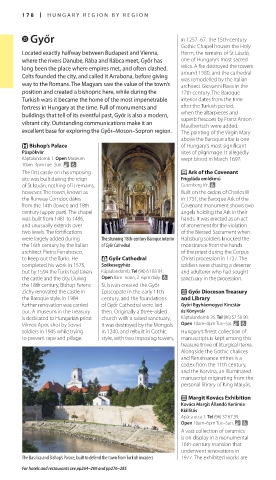
The Basilica and Bishop’s Palace, built to defend the town from Turkish invaders 1977. The exhibited works are RÉVAI M I K LÓ S UTC A
For hotels and restaurants see pp264–269 and pp276–285 For keys to map symbols see back flap
178-179_EW_Hungary.indd 178 18/09/17 3:37 pm 178-179_EW_Hungary.indd 179 18/09/17 3:37 pm

