


Page 196 - (DK Eyewitness) Travel Guide - Hungary
P. 196
194 HUNGAR Y REGION B Y REGION SOUTHERN TR ANSD ANUBIA 195
House (Török-Ház), is a small
exhibition of life in the town Hungary’s Minorities
during the Turkish occupation.
On the field where Zrínyi led Some 90 per cent of Hungary’s population are Magyars, but there are also significant
his forces into battle (5 km/ minority groups of Serbs, Germans, Romanians and Jews. In all, 13 minority groups are
3 miles north of the town) recognized, although some (the Palóc, Armenians and Ruthenians, for example) number
stands the Turkish-Hungarian
Friendship Park, set up in 1996 only a handful of people. The largest ethnic minority in Hungary is the Gypsies (Roma).
by both governments. There is The official figure is 400,000, yet many Gypsies see themselves as Hungarians, which
a replica of Sultan Süleyman’s means there could be as many as a million in the country. Until Hungary joined the EU in
tomb, and oversized statues of 2004, it had a less than fine record in its treatment of its ethnic minorities, especially of
the Sultan and of Zrínyi. the Gypsies. Even since then, EU-funded programmes have been only marginally suc-
cessful at integrating the Gypsy population.
E Castle Museum
Vár utca 19. Open check website for
opening times. ∑ szigethvar.hu The museum village of
E Turkish House Hollókő, while primarily a
Bástya utca 3. Tel (73) 51 43 00. tourist attraction, show
A typical 19th-century house in the open-air folk museum in Szenna & 7 cases Palóc traditions and
culture. Its inhabitants
q Szenna were running desperately wear traditional costume.
Road Map B5. * 750. short of water did they leave e Nagyatád
@ from Kaposvár. the fortress, and even then 28 km (18 miles) north of Barcs.
they did not surrender, Road Map B5. * 13,000. @ from
The open-air Szenna Ethno choosing instead to die heroic Kaposvár. n Tourinform, Széchenyi Few Roma still
graphic Museum is unique in though futile deaths in close tér 1/A, Nagyatád (82) 35 15 06. live the romantic
Hungary in that it has been combat. Part of the fortress, life of a traveller.
established in a living village. restored in the 1960s, is the This city has a good thermal Szentendre was Most are on the
Set around the village church, Castle Museum, dedicated to baths complex, with three founded by Serbs fringes of society,
with an un
five thatched houses with the heroes of the siege. There covered and two large open-air and although they employment
wooden porches were brought is also a monument to the pools as well as drinking cures, no longer make up the rate of almost
here from surrounding villages fallen in the town’s central but Nagyatád is best known for majority population 70 per cent.
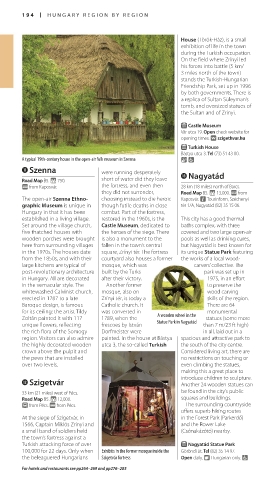
in the 1970s. The houses date square, Zrínyi tér. The fortress its unique Statue Park featuring group here, many
from the 1850s, and with their courtyard also houses a former the works of a local wood- Serbs still celebrate
large kitchens are typical of mosque, which was carvers’ collective. The Easter according to
post-revolutionary architecture built by the Turks park was set up in the Orthodox Julian
in Hungary. All are decorated after their victory. 1975, in an effort calendar.
in the vernacular style. The Another former to preserve the
whitewashed Calvinist church, mosque, also on wood carving
erected in 1787 to a late Zrínyi tér, is today a skills of the region.
Baroque design, is famous Catholic church. It There are 64 People in Sopron in 1921
for its ceiling: the artist Tildy was converted in A wooden wheel in the monumental voted to stay in Hungary rather
Zoltán painted it with 117 1789, when the statues (some more than join Austria. Over the next
unique flowers, reflecting frescoes by István Statue Park in Nagyatád than 7 m/23 ft high) few decades most ethnic
the rich flora of the Somogy Dorfmeister were in all, laid out in a Germans moved away, but The popular image of Gypsy
region. Visitors can also admire painted. In the house at Bástya spacious and attractive park to since 1990 many have musicians is a cigányzenekar, which is
the highly decorated wooden utca 3, the so-called Turkish the south of the city centre. returned, which has given the a Gypsy band. It is one of the few ways
crown above the pulpit and Considered living art, there are city a very international feel. Gypsies can earn a living in Hungary.
the pews that are installed no restrictions on touching or
over two levels. even climbing the statues,
making this a great place to
introduce children to sculpture.
w Szigetvár Another 24 wooden statues can
33 km (21 miles) west of Pécs. be found in the city’s public
Road Map B5. * 12,000. squares and buildings.
£ from Pécs. @ from Pécs. The surrounding countryside
offers superb hiking routes
At the siege of Szigetvár, in in the Forest Park (Parkerdő) Many Orthodox Romanians are
1566, Captain Miklós Zrínyi and and the Rower Lake settled in and around the eastern town
a small band of soldiers held (Csónakázótó) nearby. Budapest today is home to one of Europe’s most of Gyula. Although the two countries
the town’s fortress against a dynamic Jewish communities. Budapest’s synagogue have had a strained relationship for
Turkish attacking force of over E Nagyatád Statue Park is Europe’s largest, and the city boasts many Jewish centuries, more than 80,000 Romanians
100,000 for 22 days. Only when Exhibits in the former mosque inside the Göröndi út. Tel (82) 35 14 97. theatres, schools and kosher restaurants. choose to live in Hungary.
the beleaguered Hungarians Szigetvár fortress Open daily. 8 Hungarian only. 7
For hotels and restaurants see pp264–269 and pp276–285
194-195_EW_Hungary.indd 194 18/09/17 3:40 pm 194-195_EW_Hungary.indd 195 18/09/17 3:40 pm

