


Page 191 - (DK Eyewitness) Travel Guide - Hungary
P. 191
SOUTHERN TR ANSD ANUBIA 189
found. These are on display at the formerly the County Hall.
Dombóvár Region Histori cal The museum also presents
Museum (Dom bó vári an exhibition of local artifacts,
Helytörténeti Múzeum), which is including folk art that predates
also home to a possibly unique the Magyar invasion.
exhibition on the history of the Kaposvár’s town hall
artificial language Esperanto. was built in 1904 in classic
Among Dombóvár’s other Secessionist style, though
attractions are the Baroque its slender spire carries a
Catholic Church, dating from hint of the late Baroque. It
1757 and once a private chapel is not officially open to the
for the use of the Esterházy public but it is usually
family (see p171). Szigeterdő, a possible to go in and admire
pretty park and nature reserve the interior. The frescoes
on Gyenis Antal utca, houses a above the lobby are by local
reconstructed medieval building. artist Géza Udvary, and the
A short drive north is the tiny fine stained-glass windows
village of Gölle, the birth place of the ceremonial hall are
of István Fekete (1900–70), one of the work of the Miksa
Hungary’s most popular 20th- Stained-glass window, town hall Róth workshop.
century writers, best known for in Kaposvár A short walk south is the
his novel Tüskevár, a charming József Rippl-Rónai Memorial
story of two boys from Buda pest Rippl-Rónai (1861–1927) and Museum, the elegant Roma
who spend their summers János Vaszary (1867–1939), two cottage where a number
around Gölle and Lake Balaton. of Hungary’s most important of Rippl-Rónai’s works and
Fekete’s childhood home in artists. It was also the birth place personal items are on show.
Gölle is now a small museum. of Imre Nagy (1896–1958),
leader of the 1956 revolution E Vaszary Gallery
E Dombóvár Region Historical (see pp48–9). Csokonai utca 1. Tel (82) 51 22 28.
Museum The city’s focal point is Open 10am–6pm Tue–Sat.
Szabadság utca 16. Tel (74) 46 57 15, Kossuth tér. Most of the main 8 Hungarian only. 7
(mobile) (20) 910 80 66. Open 8am– sights are located around this E Rippl-Rónai Museum
4pm Mon–Fri, by appointment Sat & street, including the Vaszary Fő út 10. Tel (82) 31 40 11.
Sun. 8 Hungarian only. 7 Gallery, which displays the Open 10am–4pm Tue–Sun.
paintings of János Vaszary, who & 7
was born in the building. There E József Rippl-Rónai
are more Vaszary works nearby Memorial Museum
in a Neo-Classical building, Fodor József utca 35. Tel (82) 51 00 49.
the former Somogy County Open Nov–Mar: 10am–4pm Tue–
Museum (now renamed the Sun; Apr–Oct: 10am–6pm Tue–Sun.
Rippl-Rónai Museum), 8 recorded tours. 7
József Rippl-Rónai
József Rippl-Rónai (1861–1927) was
one of the three most important artists
of the Hungarian Secession move ment.
Bust of the Hungarian writer István Fekete, Born in Kaposvár he mastered a pastel-
born near Dombóvár like style, seen best in his celebrated
work Mlle Dutile (1892, József Rippl-
Rónai Memorial Museum, Kaposvár).
0 Kaposvár He moved to France when the Art
Nou veau movement was at its peak.
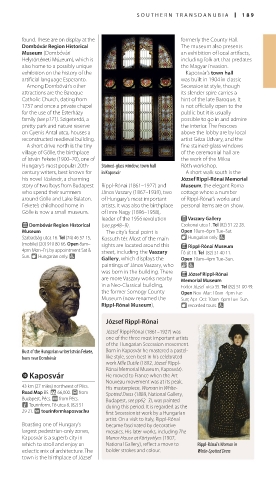
43 km (27 miles) northwest of Pécs. His masterpiece, Woman in White-
Road Map B5. * 66,000. £ from Spotted Dress (1889, National Gallery,
Budapest, Pécs. @ from Pécs. Budapest, see pp62–3), was painted
n Tourinform, Fő utca 8, (82) 51 during this period. It is regarded as the
29 21. ∑ tourinformkaposvar.hu first Secessionist work by a Hungarian
artist. On a visit to Italy, Rippl-Rónai
Boasting one of Hungary’s became fascinated by decorative
largest pedestrian-only zones, mosaics. His later works, including The
Kaposvár is a superb city in Manor House at Körtyvélyes (1907,
which to stroll and enjoy an National Gallery), reflect a move to Rippl-Rónai’s Woman in
eclectic mix of architecture. The bolder strokes and colour. White-Spotted Dress
town is the birthplace of József
188-189_EW_Hungary.indd 189 18/09/17 3:40 pm

