


Page 197 - (DK Eyewitness) Travel Guide - Hungary
P. 197
SOUTHERN TR ANSD ANUBIA 195
Hungary’s Minorities
Some 90 per cent of Hungary’s population are Magyars, but there are also significant
minority groups of Serbs, Germans, Romanians and Jews. In all, 13 minority groups are
recognized, although some (the Palóc, Armenians and Ruthenians, for example) number
only a handful of people. The largest ethnic minority in Hungary is the Gypsies (Roma).
The official figure is 400,000, yet many Gypsies see themselves as Hungarians, which
means there could be as many as a million in the country. Until Hungary joined the EU in
2004, it had a less than fine record in its treatment of its ethnic minorities, especially of
the Gypsies. Even since then, EU-funded programmes have been only marginally suc-
cessful at integrating the Gypsy population.
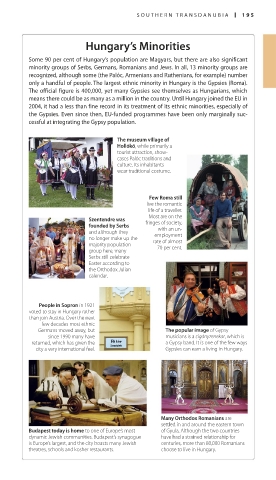
The museum village of
Hollókő, while primarily a
tourist attraction, show
cases Palóc traditions and
culture. Its inhabitants
wear traditional costume.
Few Roma still
live the romantic
life of a traveller.
Most are on the
Szentendre was fringes of society,
founded by Serbs with an un
and although they employment
no longer make up the rate of almost
majority population 70 per cent.
group here, many
Serbs still celebrate
Easter according to
the Orthodox Julian
calendar.
People in Sopron in 1921
voted to stay in Hungary rather
than join Austria. Over the next
few decades most ethnic
Germans moved away, but The popular image of Gypsy
since 1990 many have musicians is a cigányzenekar, which is
returned, which has given the a Gypsy band. It is one of the few ways
city a very international feel. Gypsies can earn a living in Hungary.
Many Orthodox Romanians are
settled in and around the eastern town
Budapest today is home to one of Europe’s most of Gyula. Although the two countries
dynamic Jewish communities. Budapest’s synagogue have had a strained relationship for
is Europe’s largest, and the city boasts many Jewish centuries, more than 80,000 Romanians
theatres, schools and kosher restaurants. choose to live in Hungary.
194-195_EW_Hungary.indd 195 18/09/17 3:40 pm

