


Page 234 - (DK Eyewitness) Travel Guide - Hungary
P. 234
232 HUNGAR Y REGION B Y REGION THE NOR THERN HIGHLANDS 233
r Tokaj Ural owls, spoonbill ducks and Lajos Kossuth stands in the
40 km (25 miles) northwest of a large number of butter flies, middle of the square that is
Nyíre gy háza. Road Map F2. many of which, such as the named after him.
* 4,600. £ from Miskolc. @ from twin-spotted fritillary, are Just north of the town hall
Debrecen, Buda pest. n Tourinform, thought to be unique to the stands a NeoClassical build ing
Serház utca 1, (47) 35 21 25. Zemplén mountain range. that houses the Ferenc
Further north, in the tiny Kazinczy Museum, named
At the confluence of the village of Füzér, is the Füzér after the language reformer
rivers Bodrog and Tisza, Village Museum, consisting Ferenc Kazinczy, a tireless
rich, fertile soil facilitates of just one painted house, campaigner for replacing German
the cultivation of Hungary’s furnished as it would have been with Hungarian as the nation’s
best grapevines. These in the 1870s. High above the official language and a reformer
produce the country’s finest village on a crag sit the ruins of the Hun garian language
wines. Smooth and delicately of Füzér Castle (1310). itself. The museum contains
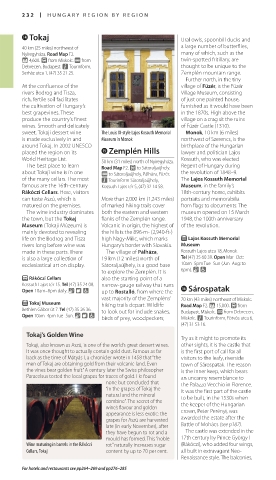
sweet, Tokaji dessert wine The Louis XI-style Lajos Kossuth Memorial Monok, 10 km (6 miles) exhibits about Kazinczy’s work,
is made exclusively in and Museum in Monok northwest of Szerencs, is the as well as regional history.
around Tokaj. In 2002 UNESCO birthplace of the Hungarian The Neo-Renaissance Castle in Sárospatak, home to the Rákóczi Museum Kazinczy died in a cholera
placed the region on its t Zemplén Hills lawyer and politician Lajos epidemic in 1831 and is buried
World Heritage List. 50 km (31 miles) north of Nyíregy háza. Kossuth, who was elected loggias and entrances are all u Sátoraljaújhely in the elaborate Kazinczy
The best place to learn Road Map F2. £ to Sátoral jaújhely. Regent of Hungary during fabulously expres sive. Much 13 km (8 miles) northeast of Sáros Mausoleum (and memorial
about Tokaji wine is in one @ to Sátoraljaújhely, Pálháza, Füzér. the revolution of 1848–9. of this part of the castle is today patak. Road Map F2. * 18,000. museum) at Széphalom, 3 km
of the many cellars. The most n Tourinform Sátoraljaújhely, The Lajos Kossuth Memorial given over to the Rákóczi £ from Miskolc. @ from Sáros patak. (2 miles) north of the town
famous are the 16th-century Kossuth Lajos tér 5, (47) 32 14 58. Museum, in the family’s Museum, which has exhibitions n Tourinform, Kossuth Lajos tér 5, centre. Visited by tens of
Rákóczi Cellars. Here, visitors 18th-century home, exhibits on the building of the castle and (47) 32 14 58. thousands of literary pilgrims
can taste Aszú, which is More than 2,000 km (1,243 miles) portraits and memorabilia the history of the Rákóczi family, each year, the NeoClassical
matured on the premises. of marked hiking trails cover from flags to documents. The as well as Renaissanceera food At the foot of the Zemplén mausoleum was designed by
The wine industry dominates both the eastern and western museum opened on 15 March and winemaking. Hills, Sátoraljaújhely, the most Miklós Ybl (see p93) and built on
the town, but the Tokaj flanks of the Zem plén range. 1948, the 100th anniversary At the opposite end of the northerly town in Hungary, the site of the Kazinczy mansion.
Museum (Tokaji Múzeum) is Volcanic in origin, the highest of of the revolution. town centre is the Calvinist is known for its atmospheric Near Kazinczy Ferenc utca,
mainly devoted to revealing the hills is the 896-m- (2,940-ft-) Sárospatak Reformed College, Baroque centre. Most of the a derelict synagogue and its
life on the Bodrog and Tisza high Nagy-Milic, which marks E Lajos Kossuth Memorial founded in 1531 but dating in town’s sights are based on cemetery are sad reminders
rivers long before wine was Hungary’s border with Slovakia. Museum its present form from 1806–22. Kossuth Lajos tér, and of all of the Jewish community that
made in these parts. There The village of Pálháza, Kossuth Lajos utca 18, Monok. There are guided tours of the the squares named for that once lived here. Only a handful
is also a large collection of 19 km (12 miles) north of Tel (47) 35 60 39. Open Mar–Oct: library in the south wing, a revolu tionary in Hungary, this of the town’s Jews survived
ecclesiastical art on display. Sátoraljaújhely, is a good base 10am–5pm Tue–Sun (Jun–Aug: to master piece of NeoClassical is perhaps the most deserving. the Holocaust.
to explore the Zemplén. It is 6pm). & 7 archi tecture that was designed In 1830, Lajos allegedly made
P Rákóczi Cellars also the starting point of a by Mihály Pollack. Its enormous his first political speech from E Ferenc Kazinczy Museum
Kossuth Lajos tér 15. Tel (47) 35 24 08. narrow-gauge railway that runs y Sárospatak roof is supported by 16 marble the balcony of the Baroque Dózsa György utca 11. Tel (47) 32 23
Open 10am–8pm daily. & 8 7 up to Rostalló, from where the columns. In the extensive gardens town hall (built in 1762–8) that 51. Open 9am–5pm Tue–Sun. & 8
vast majority of the Zempléns’ 70 km (43 miles) northeast of Miskolc. are statues of former pupils, stands at No. 5. The build ing Hungarian only. 7
E Tokaj Museum hiking trails depart. Wildlife Road Map F2. * 15,000. £ from including the Czech humanist itself is a unique example of E Kazinczy Mausoleum
Bethlen Gábor út 7. Tel (47) 35 26 36. to look out for include snakes, Budapest, Miskolc. @ from Debrecen, Johann Amos Comenius. experimental archi tecture with Kazinczy park, Széphalom. Tel (47) 52
Open 10am–4pm Tue–Sun. & 8 7 birds of prey, woodpeckers, Miskolc. n Tourinform, Eötvös utca 6, The modernist shopping its short, squat ground floor 12 36. Open Apr–Oct: 9am–5pm Tue–
(47) 31 53 16. centre and apartment build ings topped by an oversized upper Sun; Nov–Mar: 8am–4pm Tue–Sun.
Tokaj’s Golden Wine in the centre of the city, the level. An imposing statue of & 8 7
Try as it might to promote its work of local architect Imre
Tokaji, also known as Aszú, is one of the world’s great dessert wines. other sights, it is the castle that Makovecz, are also worth
It was once thought to actually con tain gold dust. Famous as far is the first port of call for all seeing. Built in 1972, the four
back as the time of Mátyás I, a chronicler wrote in 1458 that “the visitors to the leafy, riverside storey build ings form a series
men of Tokaj are obtaining gold from their volcanic land. Even town of Sárospatak. The reason of interlinking white towers, all
the vines bear golden fruit.” A century later the Swiss philosopher is the inner keep, which bears leaning slightly forwards and
Paracelsus tested the local grapes for traces of gold. He found an uncanny resem blance to topped with steep brown roofs
none but concluded that the Palazzo Vecchio in Florence. – a modern interpretation of
“in the grapes of Tokaj the It was the first part of the castle Árpád tents.
natural and the mineral to be built, in the 1530s when
combine”. The secret of the E Rákóczi Museum
wine’s flavour and golden the keeper of the Hungarian Szent Erzsébet utca 19. Tel (47) 31 10
appearance is less exotic: the crown, Peter Perényi, was 83. Open 10am–6pm Tue–Sun. &
grapes for Aszú are harvested awarded the estate after the 8 7
late (in early November), after Battle of Mohács (see p187).
they have begun to rot and a The castle was extended in the P Sárospatak Reformed College
mould has formed. This “noble 17th century by Prince György I Rákóczi út 1. Tel (47) 31 10 57.
Wine maturing in barrels in the Rákóczi rot” naturally increases sugar (Rákóczi), who added four wings, Library: Open Mar–Oct: 9am–5pm
Cellars, Tokaj content by up to 70 per cent. all built in extra vagant Neo- Mon–Sat, 9am–1pm Sun; Nov–Feb:
Renaissance style. The balconies, by appointment only. & 8 7 Original furniture at the Ferenc Kazinczy Museum in Sátoraljaújhely
For hotels and restaurants see pp264–269 and pp276–285
232-233_EW_Hungary.indd 232 18/09/17 3:41 pm 232-233_EW_Hungary.indd 233 18/09/17 3:41 pm

