


Page 236 - (DK Eyewitness) Travel Guide - Hungary
P. 236
HUNGAR Y REGION B Y REGION 235
THE GREAT
PLAIN
If Budapest is Hungary’s heart, then her soul is the
Great Plain, where her character has been forged over
the centuries, and preserved ever since in the work of the
nation’s writers, poets and musicians. Nomadic horsemen and their cattle,
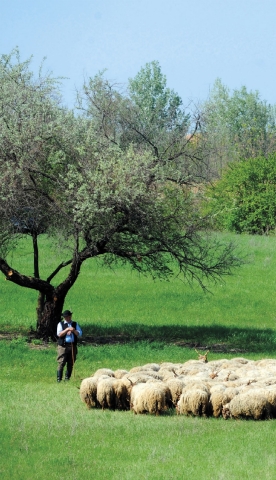
shepherds and their unique sheep, fields of ripening paprika and fish soup in
huge kettles over open fires are evocative images that every visitor should see.
Mainly barren and dry, the Great Plain is a livestock. The population fled to the
vast area, covering more than half of the cities of Debrecen, Nyíregyháza, Szeged,
country (about 56 per cent). Here, long, Kecskemét and even Budapest for
hot summers give way to bleak, freezing protection, food and livelihoods, and the
winters, with little in between. However, term Puszta was coined to describe the
there is a wide variety of terrain on the emptiness left in the Ottoman wake.
Great Plain, as well as some outstanding A few hearty souls stayed on. The
cities and a diverse flora and fauna. csikósok horsemen (see p239) thrived,
As recently as medieval times, the as severe flooding in the 19th century
Great Plain was, in fact, not a steppe, but allowed the grass to regrow, making
forested and lush, rich in agriculture and the Plain prime grazing territory.
dotted with thousands of farmsteads that Fortunes were made by cattle owners,
were set up by the Magyars as they and romantic poets wrote of the
populated these fertile lands on both heroes and villains.
banks of the Tisza. And this is where the The csikósok survive, but today their
legends begin: the Turks invaded Hungary, traditions only entertain visitors. At the
and almost two centuries of constant war, Hortobágy National Park and in other
from 1526 to 1699, devastated the region. protected areas of the Plain, these historic
In many parts they chopped down the grasslands are sheltered from the
forests and burned vegetation and advances of industrial agriculture.
Zsolnay ceramic tiles on Kiskunfélegyháza’s Secession-era Town Hall
A flock of characteristic longhaired sheep, or racka, grazing on lush grass
234_235_EW_Hungary.indd 234 18/09/17 3:41 pm 234_235_EW_Hungary.indd 235 18/09/17 3:41 pm

