


Page 235 - (DK Eyewitness) Travel Guide - Hungary
P. 235
THE NOR THERN HIGHLANDS 233
Lajos Kossuth stands in the
middle of the square that is
named after him.
Just north of the town hall
stands a NeoClassical build ing
that houses the Ferenc
Kazinczy Museum, named
after the language reformer
Ferenc Kazinczy, a tireless
campaigner for replacing German
with Hungarian as the nation’s
official language and a reformer
of the Hun garian language
itself. The museum contains
exhibits about Kazinczy’s work,
as well as regional history.
The Neo-Renaissance Castle in Sárospatak, home to the Rákóczi Museum Kazinczy died in a cholera
epidemic in 1831 and is buried
loggias and entrances are all u Sátoraljaújhely in the elaborate Kazinczy
fabulously expres sive. Much 13 km (8 miles) northeast of Sáros Mausoleum (and memorial
of this part of the castle is today patak. Road Map F2. * 18,000. museum) at Széphalom, 3 km
given over to the Rákóczi £ from Miskolc. @ from Sáros patak. (2 miles) north of the town
Museum, which has exhibitions n Tourinform, Kossuth Lajos tér 5, centre. Visited by tens of
on the building of the castle and (47) 32 14 58. thousands of literary pilgrims
the history of the Rákóczi family, each year, the NeoClassical
as well as Renaissanceera food At the foot of the Zemplén mausoleum was designed by
and winemaking. Hills, Sátoraljaújhely, the most Miklós Ybl (see p93) and built on
At the opposite end of the northerly town in Hungary, the site of the Kazinczy mansion.
town centre is the Calvinist is known for its atmospheric Near Kazinczy Ferenc utca,
Sárospatak Reformed College, Baroque centre. Most of the a derelict synagogue and its
founded in 1531 but dating in town’s sights are based on cemetery are sad reminders
its present form from 1806–22. Kossuth Lajos tér, and of all of the Jewish community that
There are guided tours of the the squares named for that once lived here. Only a handful
library in the south wing, a revolu tionary in Hungary, this of the town’s Jews survived
master piece of NeoClassical is perhaps the most deserving. the Holocaust.
archi tecture that was designed In 1830, Lajos allegedly made
by Mihály Pollack. Its enormous his first political speech from E Ferenc Kazinczy Museum
roof is supported by 16 marble the balcony of the Baroque Dózsa György utca 11. Tel (47) 32 23
columns. In the extensive gardens town hall (built in 1762–8) that 51. Open 9am–5pm Tue–Sun. & 8
are statues of former pupils, stands at No. 5. The build ing Hungarian only. 7
including the Czech humanist itself is a unique example of E Kazinczy Mausoleum
Johann Amos Comenius. experimental archi tecture with Kazinczy park, Széphalom. Tel (47) 52
The modernist shopping its short, squat ground floor 12 36. Open Apr–Oct: 9am–5pm Tue–
centre and apartment build ings topped by an oversized upper Sun; Nov–Mar: 8am–4pm Tue–Sun.
in the centre of the city, the level. An imposing statue of & 8 7
work of local architect Imre
Makovecz, are also worth
seeing. Built in 1972, the four
storey build ings form a series
of interlinking white towers, all
leaning slightly forwards and
topped with steep brown roofs
– a modern interpretation of
Árpád tents.
E Rákóczi Museum
Szent Erzsébet utca 19. Tel (47) 31 10
83. Open 10am–6pm Tue–Sun. &
8 7
P Sárospatak Reformed College
Rákóczi út 1. Tel (47) 31 10 57.
Library: Open Mar–Oct: 9am–5pm
Mon–Sat, 9am–1pm Sun; Nov–Feb:
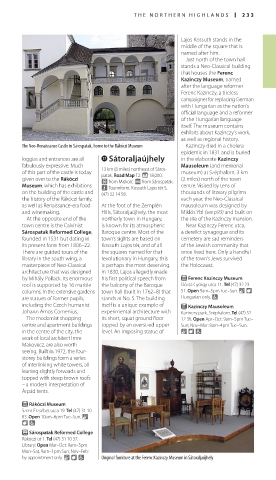
by appointment only. & 8 7 Original furniture at the Ferenc Kazinczy Museum in Sátoraljaújhely
232-233_EW_Hungary.indd 233 18/09/17 3:41 pm

