


Page 246 - (DK Eyewitness) Travel Guide - Hungary
P. 246
244 HUNGAR Y REGION B Y REGION THE GREA T PLAIN 245
8 Ópusztaszer Ethno graphic Museum Budapest. The city’s substantial
National Historical comprising some 19th-century castle was built by St István
Memorial Park houses, wind mills, farm houses in 1075 but sacked first by the
and workshops from the local
Mongols, then by the Turks, so
Ópusztaszeri Nemzeti Történeti area. In summer the work shops that nothing remains of it today.
Emlékpark demonstrate various folk crafts, The most important historical
31 km (19 miles) north of Szeged. and much of what is produced monument in the city now, a
Road Map E5. £ to Kistelek, then is sold. To the left of the short walk west of the centre, is
coach. @ from Kistelek, local bus museum stand tents known the Baroque Francis can church,
from Ópusztaszer. n Tourinform, as yurts. built in 1727–54. On the way
Szo bor kert 68, Ópusz taszer, (62) 27 51 The Feszty Panorama, an is the former synagogue at
33. Open Apr–Oct: 10am–6pm Tue– astonishingly detailed Gyula Castle, almost intact after many years of Turkish rule Templom utca 2, a Seces sionist
Sun; Nov–Mar: 10am–4pm Tue–Sun. depiction of the Magyar building, restored in the 1950s.
Feszty Panorama: Open guided tours migration onto the Great Plain, of the event is based on Kossuth of Hungary’s best thermal bath Also worth a visit is the János
Decorative detail of the Town Hall roof only. Tel (62) 27 52 57. & 7 - = can be seen here. The 120-m- tér, a large pedestrianized complexes. The mansion also Damjanich Museum, north of
in Kiskunfélegyháza ∑ opusztaszer.hu (394-ft-) long painting, created square. Here stands the large features an exhibi tion on every- the centre. Named after the
6 Kiskunfélegyháza According to legend it was on by 24 artists in 1892–4, was Secessionist Town Hall, whose day life – and life as a servant – in general who led the Hungarians
a Hungarian mansion.
badly damaged in World War II
tower can be climbed. The
to victory over the Habsburgs in
28 km (18 miles) south of Kecs kemét. this site in 896 that the Magyar but has been restored and can building next door (formerly a Another attraction is the the Battle of Szolnok in 1849, it
Road Map D4. * 30,000. £ from clan chiefs made their blood be viewed by appointment. school) now houses the Alföld charming Százéves, Hungary’s exhibits folk art, archaeological
Kecskemét, Budapest. @ from pact and chose Árpád as their Gallery, which exhibits the second-oldest café, which items, and work by the Szolnok
Kecskemét, Budapest. single leader. The enormous work of Great Plain artists, for opened in 1840. Ferenc Erkel, Artists Colony.
Neo-Classical Árpád Memorial, 9 Hódmezővásár example, József Koszta, Gyula who composed grand operas
Kiskunfélegyháza has a Roman erected in 1896 for Hun gary’s hely Rudnay and Vilmos Aba-Novák. and the Hungarian national
Catholic church and a regional Millennium Celebrations (see The enormous New Calvinist anthem, was born in the house
museum, but the Secessionist p108), commemorates the event. 25 km (15 miles) northeast of Szeged. church is impressive but a fair at Apor Vilmos tér 7. It now has
Town Hall is really the only Before that, a monastery stood Road Map E5. * 45,000. £ from walk east along Andrássy utca. a small museum dedicated to
sight worth seeing in this here, from perhaps the 12th Szeged. @ from Szeged. Andrassy Opposite is a superb Secession- his life and work.
southern town. It is truly century (its ruins can still be seen), út, Kossuth tér. n Tourinform, ist synagogue (1903), with an
outstanding. Com pleted in and it may have been a pagan Szőnyi utca 1, (62) 24 93 50. exhibition dedicated to those
_ Agricultural Festival (end Apr);
1912, it is some thing of a high- burial ground earlier still. In 1945, St István’s Day (20 Aug). killed in the Holocaust. It often q Szolnok
water mark for Secessionist this historic site was chosen by hosts official com mem orative 100 km (59 miles) east of Budapest.
archi tecture. Designed by the Com munists to announce One of the oldest settle ments events on Holocaust Day. Road Map E4. * 73,000. £ @ n
József Vass and Nándor their agri cultural collectivization in Hungary, the small city of Tourinform, Hild J. tér 1, (56) 42 07 04.
Morbitzer, its façade is a riot policy. North of the memorial Hódme ző vásárhely is famous
of colour, floral patterns and stands a well-presented for its Agricultural Festival. Much 0 Gyula Located where the river Zagyva
interwoven motifs. Many of 15 km (9 miles) east of Békéscaba. flows into the Tisza, Szolnok
the patterns are, in fact, copied Road Map F4. * 31,000. £ from has long been the last obstacle The Baroque Franciscan Church, the oldest
from the folk art of the Kiskun Békéscsaba, Budapest. @ from Békés- for invaders on the road to building in Szolnok
region: they can also be seen csaba. n Tourinform, Kossuth Lajos
on traditional lace tablecloths. utca 7, (66) 56 16 80. _ Gyula Castle Hungarian Calvinism
The roof is covered entirely Open-Air Theatre Festival (Jul, Aug).
in tiles made at the Zsolnay Calvinism flourished in eastern Hungary and in Transylvania from
factory in Pécs (see pp190–93). At one time Scythians, Huns and the second half of the 16th century to around 1700. Preaching to
On a gable, the city crest Avars all passed through the a public that considered Catholicism the religion of the Habsburgs,
can be seen, surrounded by area around the present town and therefore foreign, a great number of reformers were active in
tulip motifs. of Gyula, but a settle ment called Hungary before the Reformation movements of Martin Luther and
Although the town hall is an Gyulamono stora was first ment- John Calvin. The Turks actively encouraged the Reformation as a
official building and still used ioned in 1313. The impressive bulwark against Catholicism, and the Hungarian Reformed Church
for administrative purposes castle, which miraculously quickly became the largest in central Europe. Calvinism rejected
consubstantiation, and had a theocratic view of the state, popular
today, nobody seems to mind survives almost intact, was built with Hun garians under
visitors wandering in every in the 14th–15th centuries. Taken Turkish rule. When the
day to admire the main hall, by the Turks in 1566, it stayed Turks were finally expelled
which is as richly decorated under their control for 130 years. in 1699, the Habs burgs
as the exterior. The castle is the city’s leading confiscated Calvinist
sight, and it dominates the property. This Counter-
E Town Hall sprawling park that makes central Reformation bred resent-
Kossuth Lajos utca 1. Gyula so pleasant a place. Visitors ment, and was a major
Tel (76) 46 12 55. Open 7:30am– can clamber over its walls and factor in the creation in the
4pm Mon–Fri. 7 climb the lookout tower, or in 18th century of a national
summer enjoy a concert in the independence move ment,
7 Szeged court yard. Also in the park is the both in eastern Hungary The Calvinist College in Debrecen, founded
beautifully restored 18th-century and in Transylvania. in 1538
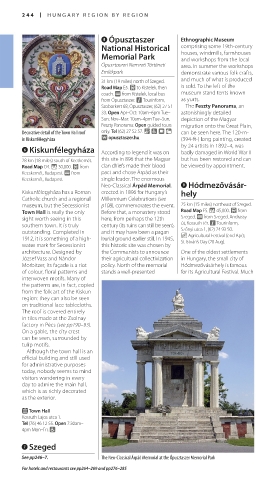
See pp246–7. The Neo-Classical Árpád Memorial at the Ópusztaszer Memorial Park Almásy Mansion, which has one
For hotels and restaurants see pp264–269 and pp276–285
244-245_EW_Hungary.indd 244 14/11/2017 16:49 244-245_EW_Hungary.indd 245 14/11/2017 16:49

