


Page 52 - (DK Eyewitness) Travel Guide - Hungary
P. 52
50 INTRODUCING HUNGAR Y THE HIST OR Y OF HUNGAR Y 51
The Hungarian road to socialism became standards for many people dropped, and
known – only slightly tongue-in-cheek – unemployment reached almost 16 per cent
as “Goulash Communism”. An increasingly in early 1994. As a result, the Socialists,
relaxed approach to censorship reduced promising a less dramatic transition to a
the number of banned works, and market economy, easily won the election
expanded the number of intellectual in 1994. Since then Hungary has seen its
works that were supported and tolerated. governments yoyo between left and right.
Uniquely among Eastern Europeans, In 1998 Fidesz replaced the Socialists, only
Hungarians were relatively free to travel for the latter to return to power in 2002.
abroad, though only after thorough Proclamation of the Republic of Hungary in 1989 They narrowly won the 2006 general
background checks. Currency regulations election, though Prime Minister Ferenc
further restricted foreign travel to for years organized themselves into political Gyurcsány’s admission of lying during
the privileged. parties. In 1989 they organized mass the campaign provoked weeks of protests.
While the Kádár regime must be given demonstrations throughout the country Gyurcsány refused to resign, however,
some credit for successfully walking a against the HWP’s monopoly on power. Led and the protests eventually died down.
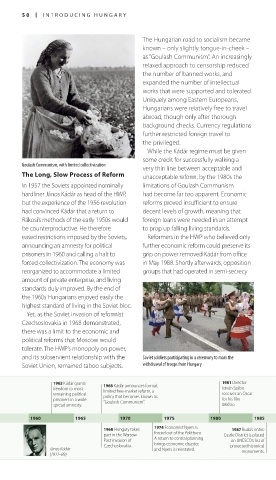
Goulash Communism, with limited collectivization
very thin line between acceptable and by the Hungarian Demo cratic Forum (MDF), A member of both NATO (2001) and the
The Long, Slow Process of Reform unacceptable reform, by the 1980s the the Alli ance of Free Democrats (SZDSZ) and European Union (2004), the 2008 global
In 1957 the Soviets appointed nominally limitations of Goulash Communism the Federation of Young Democrats (Fidesz), financial crisis hit Hungary hard. In 2010,
hardliner János Kádár as head of the HWP, had become far too apparent. Economic the opposition held talks with the govern Fidesz swept to victory with a twothirds
but the experience of the 1956 revolution reforms proved insufficient to ensure ment in March 1989, and, although no majority – the first party to govern outright
had convinced Kádár that a return to decent levels of growth, meaning that agreement was reached until autumn, the since the fall of Communism – and, despite
Rákosi’s methods of the early 1950s would foreign loans were needed in an attempt days of the oneparty state were numbered. introducing deeply unpopular austerity
be counterproductive. He therefore to prop up falling living standards. On 23 October 1989, the country’s name was measures to rescue the ailing economy,
eased restrictions imposed by the Soviets, Reformers in the HWP who believed only changed from Hungarian People’s Republic won emphatically again in 2014.
announcing an amnesty for political further economic reform could preserve its to the Republic of Hungary, a symbolic move
prisoners in 1960 and calling a halt to grip on power removed Kádár from office confirming the replacement of the oneparty
forced collectivization. The economy was in May 1988. Shortly afterwards, opposition system with a multiparty democracy.
reorganized to accommodate a limited groups that had operated in semi-secrecy
amount of private enterprise, and living Hungary Since 1990
standards duly improved. By the end of Hungary’s first postCommunist elections,
the 1960s Hungarians enjoyed easily the held in 1990, were won by the MDF. The
highest standard of living in the Soviet bloc. HWP took part as the Hungarian Socialist
Yet, as the Soviet invasion of reformist Party (MSZP), but fared poorly. Árpád Göncz,
Czecho slovakia in 1968 demonstrated, who had been sentenced to death for his
there was a limit to the economic and part in the 1956 revolution, was elected
political reforms that Moscow would president; he was to serve two fiveyear terms.
tolerate. The HWP’s monopoly on power, The 1990–94 government enacted
and its subservient relationship with the Soviet soldiers participating in a ceremony to mark the tough economic reform, including a
Soviet Union, remained taboo subjects. withdrawal of troops from Hungary massive privatization programme. Living Hungary’s accession to the European Union, 2004
1963 Kádár grants 1968 Kádár announces formal, 1981 Director 2010 Fidesz wins elections with a
freedom to most limited free-market reform, a István Szábo 1988 Kádár is Hungarian 2004 Hungary joins twothirds majority in Parliament.
remaining political policy that becomes known as receives an Oscar forced to national the Euro pean Union 2006 Gyurcsány
prisoners in a wide- “Goulash Communism”. for his film resign by his emblem on 1 May. and the Socialist 2012 A new constitution is
spread amnesty. Mefisto. Party (MSZP) win introduced on 1 Jan 2012.
own party. after 1989 the elections.
1985
1960 1965 1970 1975 1980 1985 1990 1995 2000 2005 2010 2015
1968 Hungary takes 1974 Economist Nyers is 1987 Buda’s entire 1989 In March a series of talks begins 1999 2009 Ferenc 2014 Fidesz
part in the Warsaw forced out of the Politburo. Castle District is placed that will see the HWP renounce its Hungary is 2002 Imre Kertész Gyurcsány resigns wins all
Pact invasion of A return to central planning on UNESCO’s list of monopoly in October. On 23 October, admitted receives a Nobel and Gordon parliamentary,
Czechoslovakia. brings economic disaster, protected historical the Republic of Hungary becomes the to NATO. prize for literature. Bajnai becomes municipal and
János Kádár and Nyers is reinstated. monuments. country’s official name. prime minister. EP elections
(1912–89) Ferenc Gyurcsány with a landslide.
044-051_EW_Hungary.indd 50 18/09/17 3:39 pm 044-051_EW_Hungary.indd 51 18/09/17 3:39 pm

