


Page 51 - (DK Eyewitness) Travel Guide - Hungary
P. 51
THE HIST OR Y OF HUNGAR Y 49
The 1956 Hungarian Revolution
On the morning of 23 October, students and workers unhappy with falling living standards
marched on Radio Hungary in Budapest, in a bid to broadcast a list of demands, which
included the immediate withdrawal of all Soviet troops stationed in Hungary. Actively
supported by sections of the Hungarian army, the revolutionaries attacked the AVH (secret
police) and Soviet soldiers, and the revolt spread nationwide. The Hungarian Communist
Party, fearing total collapse, gave in to a number of demands, and on 27 October invited
Imre Nagy to form a new government. However, on 4 November, thousands more Soviet
troops invaded Hungary and, despite fierce resistance, quickly crushed the revolution.
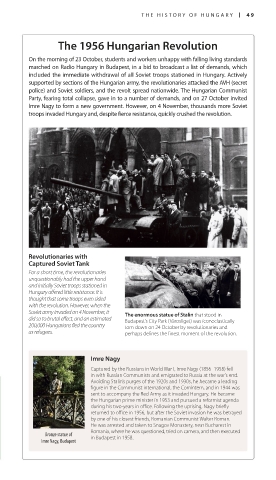
Revolutionaries with
Captured Soviet Tank
For a short time, the revolution ar ies
unquestionably had the upper hand
and initially Soviet troops stationed in
Hungary offered little resistance. It is
thought that some troops even sided
with the revolution. How ever, when the
Soviet army invaded on 4 November, it The enormous statue of Stalin that stood in
did so to brutal effect, and an estimated Budapest’s City Park (Városliget) was iconoclastically
200,000 Hungarians fled the country torn down on 24 October by revolutionaries and
as refugees. perhaps defines the finest moment of the revolution.
Imre Nagy
Captured by the Russians in World War I, Imre Nagy (1856–1958) fell
in with Russian Communists and emigrated to Russia at the war’s end.
Avoiding Stalin’s purges of the 1920s and 1930s, he became a leading
figure in the Communist international, the Comintern, and in 1944 was
sent to accompany the Red Army as it invaded Hungary. He became
the Hungarian prime minister in 1953 and pursued a reformist agenda
during his two-years in office. Following the uprising, Nagy briefly
returned to office in 1956, but after the Soviet invasion he was betrayed
by one of his closest friends, Romanian Communist Walter Roman.
He was arrested and taken to Snagov Monastery, near Bucharest in
Romania, where he was questioned, tried on camera, and then executed
Bronze statue of
Imre Nagy, Budapest in Budapest in 1958.
044-051_EW_Hungary.indd 49 18/09/17 3:39 pm

