


Page 53 - (DK Eyewitness) Travel Guide - Hungary
P. 53
THE HIST OR Y OF HUNGAR Y 51
standards for many people dropped, and
unemployment reached almost 16 per cent
in early 1994. As a result, the Socialists,
promising a less dramatic transition to a
market economy, easily won the election
in 1994. Since then Hungary has seen its
governments yoyo between left and right.
In 1998 Fidesz replaced the Socialists, only
for the latter to return to power in 2002.
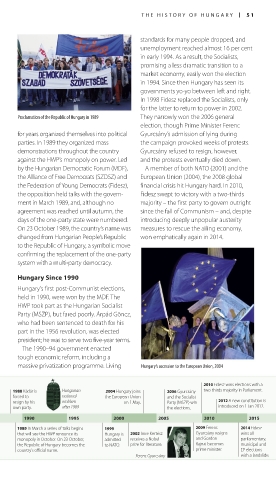
Proclamation of the Republic of Hungary in 1989 They narrowly won the 2006 general
election, though Prime Minister Ferenc
for years organized themselves into political Gyurcsány’s admission of lying during
parties. In 1989 they organized mass the campaign provoked weeks of protests.
demonstrations throughout the country Gyurcsány refused to resign, however,
against the HWP’s monopoly on power. Led and the protests eventually died down.
by the Hungarian Demo cratic Forum (MDF), A member of both NATO (2001) and the
the Alli ance of Free Democrats (SZDSZ) and European Union (2004), the 2008 global
the Federation of Young Democrats (Fidesz), financial crisis hit Hungary hard. In 2010,
the opposition held talks with the govern Fidesz swept to victory with a twothirds
ment in March 1989, and, although no majority – the first party to govern outright
agreement was reached until autumn, the since the fall of Communism – and, despite
days of the oneparty state were numbered. introducing deeply unpopular austerity
On 23 October 1989, the country’s name was measures to rescue the ailing economy,
changed from Hungarian People’s Republic won emphatically again in 2014.
to the Republic of Hungary, a symbolic move
confirming the replacement of the oneparty
system with a multiparty democracy.
Hungary Since 1990
Hungary’s first postCommunist elections,
held in 1990, were won by the MDF. The
HWP took part as the Hungarian Socialist
Party (MSZP), but fared poorly. Árpád Göncz,
who had been sentenced to death for his
part in the 1956 revolution, was elected
president; he was to serve two fiveyear terms.
The 1990–94 government enacted
tough economic reform, including a
massive privatization programme. Living Hungary’s accession to the European Union, 2004
2010 Fidesz wins elections with a
1988 Kádár is Hungarian 2004 Hungary joins 2006 Gyurcsány twothirds majority in Parliament.
forced to national the Euro pean Union and the Socialist
resign by his emblem on 1 May. Party (MSZP) win 2012 A new constitution is
own party. after 1989 the elections. introduced on 1 Jan 2012.
1985 1990 1995 2000 2005 2010 2015
1989 In March a series of talks begins 1999 2009 Ferenc 2014 Fidesz
that will see the HWP renounce its Hungary is 2002 Imre Kertész Gyurcsány resigns wins all
monopoly in October. On 23 October, admitted receives a Nobel and Gordon parliamentary,
the Republic of Hungary becomes the to NATO. prize for literature. Bajnai becomes municipal and
country’s official name. prime minister. EP elections
Ferenc Gyurcsány with a landslide.
044-051_EW_Hungary.indd 51 18/09/17 3:39 pm

