


Page 60 - (DK Eyewitness) Travel Guide - Hungary
P. 60
58 BUD APEST AREA B Y AREA C ASTLE DISTRIC T 59
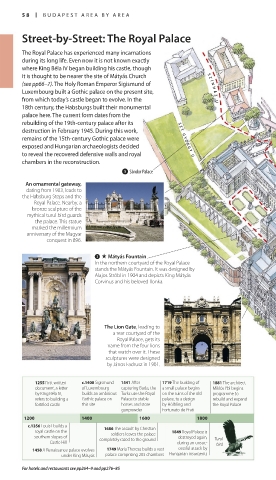
Street-by-Street: The Royal Palace The dome of the Royal Palace
was rebuilt in the Neo-Classical
style after the Neo-Baroque
The Royal Palace has experienced many incarnations dome, designed by
CASTLE
during its long life. Even now it is not known exactly Alajos Hauszmann, was DISTRICT
where King Béla IV began building his castle, though destroyed in the razing
it is thought to be nearer the site of Mátyás Church of the palace during Danube
World War II.
(see pp66–7). The Holy Roman Emperor Sigismund of HILL AND
GELLÉRT
Luxembourg built a Gothic palace on the present site, S Z Í N H Á Z U TABÁN
from which today’s castle began to evolve. In the Locator Map
18th century, the Habsburgs built their monumental See Street Finder map 1
palace here. The current form dates from the
rebuilding of the 19th-century palace after its
destruction in February 1945. During this work,
remains of the 15th-century Gothic palace were S Z T G Y Ö R G Y U
exposed and Hungarian archaeologists decided
to reveal the recovered defensive walls and royal A statue of Prince Eugene of
Savoy, by József Róna, was unveiled
chambers in the reconstruction. in 1900. It commemo rates the
5 Sándor Palace Battle of Zenta in 1697, victory
at which was a turning point in
An ornamental gateway, the Turkish war. The bas-reliefs
dating from 1903, leads to on the base depict scenes
the Habsburg Steps and the from the battle. Two Turkish
Royal Palace. Nearby, a priso ners cower by the feet
bronze sculpture of the of the prince.
mythical turul bird guards
the palace. This statue
marked the millennium
anniversary of the Magyar
conquest in 896.
3 . Mátyás Fountain
In the northern courtyard of the Royal Palace
stands the Mátyás Fountain. It was designed by
Alajos Stróbl in 1904 and depicts King Mátyás
Corvinus and his beloved Ilonka.
4 . Hungarian National Gallery
Artworks depicting Hungary’s turbulent history
are displayed here. Periods of both foreign
domination and patriotic home rule are brought
The Lion Gate, leading to to life through the gallery’s extensive collection.
a rear courtyard of the
Royal Palace, gets its
name from the four lions 0 metres 50
that watch over it. These 0 yards 50
sculptures were designed
by János Fadrusz in 1901.
Building the Royal Palace
1255 First written c.1400 Sigismund 1541 After 1719 The building of 1881 The architect
document, a letter of Luxembourg capturing Buda, the a small palace begins Miklós Ybl begins In the early 15th century, a Gothic Royal
by King Béla IV, builds an ambit ious Turks use the Royal on the ruins of the old programme to
refers to building a Gothic pal ace on Palace to stable palace, to a design rebuild and expand Palace was built on the site, but it was rebuilt
fortified castle this site horses and store by Hölbling and the Royal Palace in the Renaissance style by King Mátyás in 1458.
gunpowder Fortunato de Prati 2 National After the Turkish occupation it was razed and
Széchényi Library reborn on a smaller scale. Maria Theresa further
1200 1400 1600 1800 1 Budapest developed the palace and it was rebuilt again
c.1356 Louis I builds a 1686 The assault by Christian History Museum after World War II to a design originally
royal castle on the soldiers leaves the palace 1849 Royal Palace is completed in 1905.
southern slopes of completely razed to the ground destroyed again, Turul
Castle Hill during an unsuc bird Key 15th century 1749
1458 A Renaissance palace evolves 1749 Maria Theresa builds a vast cessful attack by Suggested route 1719 1905
under King Mátyás palace comprising 203 chambers Hungarian insurgents
For hotels and restaurants see pp264–9 and pp276–85
Hun_058-059_SS.indd 58 17/02/2015 12:58 Hun_058-059_SS.indd 59 17/02/2015 12:58

