


Page 62 - (DK Eyewitness) Travel Guide - Hungary
P. 62
60 BUD APEST AREA B Y AREA C ASTLE DISTRIC T 61
1985, in the Royal Palace hunting expedition, meets a
Building “F”, built in 1890–1902 beautiful peasant girl, Ilonka,
by Alajos Hauszmann and who falls in love with him,
Miklós Ybl (see p93). Among but their love is doomed. This
the national library’s most representation shows King
precious treasures are 35 pieces Mátyás disguised as hunter,
from the Bibliotheca Corviniana, standing proudly with his kill.
a collection of ancient books He is accompanied by his chief
and manu scripts that originally hunter and several hunting
belonged to King Mátyás dogs in the central part of the
Corvinus (see pp40–41). His fountain. Below the left-hand
collection was one of the largest columns sits Galeotto Marzio,
Renaissance libraries in Europe. an Italian court poet, and the
Also of importance are the figure of the young Ilonka is The imposing entrance to the tunnel on Clark Ádám tér
earliest-surviving records in below the columns on the right.
the Hungarian language, dating In keeping with the romantic elevation depicts Greek gods on The entrance on Clark Ádám
from the early 13th century. reputation of King Mátyás, a Mount Olympus. The south side tér is flanked by two pairs
The library was established new tradition has grown up shows Count Sándor being of Doric columns. The square in
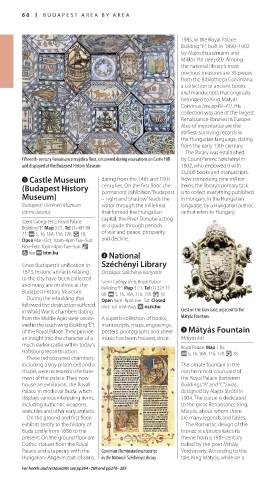
Fifteenth-century Renaissance majolica floor, uncovered during excavations on Castle Hill by Count Ferenc Széchényi in concerning this statue. The knighted, and the north ern front of the tunnel is the city’s
and displayed at the Budapest History Museum 1802, who endowed it with belief is that anyone wishing façade features a 1934 sculpture official centre because of the
35,000 books and manu scripts. to revisit Budapest should of St George by Zsigmond location here of the Zero
1 Castle Museum dating from the 14th and 15th Now comprising nine million throw a coin into the fountain Kisfaludi Strobl. Kilometre Stone, from which all
(Budapest History centuries. On the first floor, the items, the library’s primary task to ensure their safe return. Sándor Palace functioned as distan ces from Budapest are
permanent exhibition “Budapest is to collect everything published the prime minister’s official calculated.
Museum) – Light and Shadow” leads the in Hungary, in the Hungarian 4 Hungarian residence from 1867 to 1944, The tunnel’s western entrance
Budapesti Történeti Múzeum visitor through the millennia language, by a Hungarian author, when it was severely damaged was originally orna mented with
Vármúzeuma that formed the Hungarian or that refers to Hungary. National Gallery in World War II. It has been Egyptian motifs. However, it
capital, the River Danube acting Magyar Nemzeti Galéria completely restored and is now was rebuilt with out these
Szent György tér 2, Royal Palace
Building “E”. Map 3 C1. Tel (1) 487 88 as a guide through periods See pp62–3. the official residence of the details after it was damaged in
71. @ 5, 16, 16A, 116, 178. v 18. of war and peace, prosperity President of Hungary. World War II.
Open Mar–Oct: 10am–6pm Tue–Sun; and decline.
Nov–Feb: 10am–4pm Tue–Sun. & 5 Sándor Palace
7 fee ∑ btm.hu Sándor-palota 6 Tunnel 7 Parade Square
2 National Dísz tér
Szent György tér 1–3. Map 1 B5. Alagút
Since Budapest’s unification in Széchényi Library @ 16, 16A, 116. Open only on special Map 1 B5.
1873, historic artifacts relating Országos Széchényi Könyvtár occasions. ∑ keh.hu Clark Ádám tér. Map 1 C5. @ 16, 16A, 116.
@ 16, 86.
to the city have been collected Szent György tér 6, Royal Palace
and many are on show at the Building “F”. Map 3 C1. Tel (1) 224 37 By the top of the cog-wheel The Scottish engineer Adam In the past, Parade Square was
Budapest History Museum. 00. @ 5, 16, 16A, 116, 178. v 18. railway stands the grand Clark settled in Hungary a marketplace and a site of
During the rebuilding that Open 9am–8pm Tue–Sat. Closed Neo-Classical mansion, Sándor after completing the Chain execution. It is named after the
followed the destruction suffered mid- Jul–mid-Aug. ∑ oszk.hu Palace. It was commissioned Bridge. One of his later military parades that were held
in World War II, chambers dating Crest on the Lion Gate, adjacent to the in 1806 by Count Vincent projects, in 1853–7, was here in the 19th century. At the
from the Middle Ages were uncov- A superb collection of books, Mátyás Fountain Sándor from architects Mihály the construction of the northern end of the square is
ered in the south wing (Building “E”) manuscripts, maps, engravings, Pollack and Johann Aman. tunnel that runs right through the Honvéd Monu ment, built in
of the Royal Palace. They provide posters, photographs and sheet 3 Mátyás Fountain The bas-reliefs that decorate Castle Hill, from Clark Ádám 1893 by György Zala. It honours
an insight into the character of a music has been housed, since Mátyás kút the palace are the work of tér to Krisztinaváros. The and com memorates those
much earlier castle within today’s Royal Palace. Map 1 B5. Richárd Török, Miklós Melocco tunnel is 350 m (1,150 ft) who died during the recapture
Habs burg reconstruction. @ 5, 16, 16A, 116, 178. v 18. and Tamás Körössényi. The long, 9 m (30 ft) wide and of Buda from Austria in the
These rediscovered chambers, decoration on the western 11 m (36 ft) in height. 1848 revolution.
including a tiny prison cell and a The ornate fountain in the The two-floor Baroque palace
chapel, were recreated in the base- northernmost courtyard of at No. 3 was the home of the
ment of the palace. They now the Royal Palace (between Batthyány family until 1945.
house an exhibition, the Royal Build ings “A” and “C”) was It was built between 1743
Palace in medieval Buda, which designed by Alajos Stróbl in and 1748 by József Giessl,
displays various interesting items, 1904. The statue is dedicated and, although it has been
including authentic weapons, to the great Renaissance king, frequently remodelled, the
seals, tiles and other early artifacts. Mátyás, about whom there façade remains intact.
On the ground and first floor, are many legends and fables. A few houses on Parade
exhibits testify to the history of The Romantic design of the Square incorporate medieval
Buda castle from 1686 to the bronze sculptures takes its remains. Examples can be seen
present. On the ground floor are theme from a 19th-century at Nos. 4–5 and No. 11, built by
Gothic statues from the Royal ballad by the poet Mihály Venerio Ceresola. The former
Palace and a tapestry with the Corvinian illuminated manuscript Vörösmarty. According to the has seat niches dating from
Hungarian–Angevin coat-of-arms, in the National Széchényi Library tale, King Mátyás, while on a The western elevation of the Neo-Classical Sándor Palace the 13th century.
For hotels and restaurants see pp264–269 and pp276–285
060-061_EW_Hungary.indd 60 19/09/17 10:45 am 060-061_EW_Hungary.indd 61 19/09/17 10:45 am

