


Page 443 - Tagalog for Beginners: An Introduction to Filipino, the National Language of the Philippines
P. 443
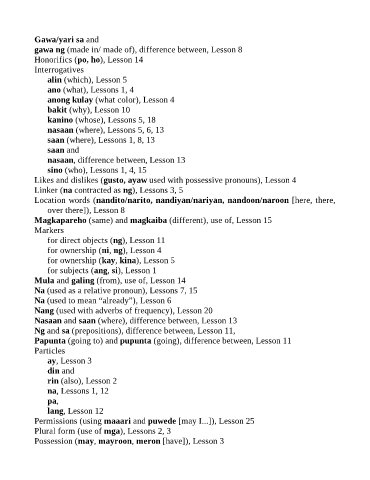
Gawa/yari sa and
            gawa ng (made in/ made of), difference between, Lesson 8
            Honorifics (po, ho), Lesson 14
            Interrogatives
                 alin (which), Lesson 5
                 ano (what), Lessons 1, 4
                 anong kulay (what color), Lesson 4
                 bakit (why), Lesson 10
                 kanino (whose), Lessons 5, 18
                 nasaan (where), Lessons 5, 6, 13
                 saan (where), Lessons 1, 8, 13
                 saan and
                 nasaan, difference between, Lesson 13
                 sino (who), Lessons 1, 4, 15
            Likes and dislikes (gusto, ayaw used with possessive pronouns), Lesson 4
            Linker (na contracted as ng), Lessons 3, 5

            Location words (nandito/narito, nandiyan/nariyan, nandoon/naroon [here, there,
                 over there]), Lesson 8
            Magkapareho (same) and magkaiba (different), use of, Lesson 15
            Markers
                 for direct objects (ng), Lesson 11
                 for ownership (ni, ng), Lesson 4
                 for ownership (kay, kina), Lesson 5
                 for subjects (ang, si), Lesson 1
            Mula and galing (from), use of, Lesson 14
            Na (used as a relative pronoun), Lessons 7, 15
            Na (used to mean “already”), Lesson 6
            Nang (used with adverbs of frequency), Lesson 20

            Nasaan and saan (where), difference between, Lesson 13
            Ng and sa (prepositions), difference between, Lesson 11,
            Papunta (going to) and pupunta (going), difference between, Lesson 11
            Particles
                 ay, Lesson 3
                 din and
                 rin (also), Lesson 2
                 na, Lessons 1, 12
                 pa,
                 lang, Lesson 12
            Permissions (using maaari and puwede [may I...]), Lesson 25
            Plural form (use of mga), Lessons 2, 3
            Possession (may, mayroon, meron [have]), Lesson 3

